In multi-shift intralogistics distribution centers, automated container terminals, and manufacturing mega-plants, industrial material handling fleets represent massive distributed energy and mechanical capital. Managing 50 to 500 electric forklifts across multiple enterprise facilities requires moving beyond isolated dashboard fault lights to continuous, cloud-connected fleet telemetry. However, bridging raw deterministic vehicle controller-area networks (SAE J1939 / CANopen at 250 kbps to 500 kbps) to modern cloud analytics platforms presents severe architectural hurdles: noisy RF warehouse environments, intermittent cellular/Wi-Fi dead zones, high-frequency CAN message saturation (thousands of frames per second), and stringent cybersecurity boundaries. This engineering guide details the hardware architecture, edge-filtering algorithms, secure CAN-to-MQTT protocol translation, and digital-twin State of Health (SOH) electrochemical modeling that empower next-generation industrial forklift fleet telematics in compliance with ISO 21434 and IEC 62443 standards.
1. Vehicle Telematics Hardware: The Automotive Edge Gateway Topology
An industrial forklift telematics gateway acts as the secure physical and protocol bridge between the vehicle internal control networks and remote cloud enterprise servers:
- Dual Galvanically Isolated CAN Interfaces: The gateway incorporates dual independent high-speed CAN transceivers (complying with ISO 11898-2) featuring $2.5 ext{ kV}$ galvanic isolation. Channel 1 taps the primary vehicle traction/hydraulic drivetrain bus (monitoring motor RPM, throttle position, hydraulic pressure, and brake pedal inputs). Channel 2 interfaces directly with the dedicated LiFePO4 battery management system (BMS), logging individual cell voltages, internal shunt currents, and temperatures.
- Heterogeneous Wireless Connectivity: Dual-band Wi-Fi (802.11 a/b/g/n/ac) provides high-bandwidth data offloading when the forklift docks at automated opportunity charging stations. For wide-area outdoor lumber yards, shipping ports, or agricultural depots, a global LTE-M / NB-IoT cellular modem with fallback 2G/4G connectivity ensures continuous telemetry reporting.
- High-Shock Hardware Packaging (IP67): Enclosed within a die-cast aluminum or heavy polycarbonate housing rated to IP67. The internal power supply features wide DC input tolerance (9V to 135V DC), absorbing severe voltage spikes ($>200 ext{ V}$) and inductive load dumps caused by DC PDU contactor cycling.
2. The Protocol Translation Pipeline: SAE J1939 to MQTT JSON
Streaming raw CAN frames directly over cellular connections would incur unsustainable data transmission costs and overwhelm cloud ingest endpoints. The edge gateway executes local stream preprocessing:

The comparative matrix below illustrates the structural transition from raw binary vehicle bus packets to cloud-optimized telemetry payloads:
| Engineering Attribute | Raw Vehicle Bus (SAE J1939) | Edge Pre-Processed Buffer | Cloud Telemetry Payload (MQTT / TLS) |
|---|---|---|---|
| Protocol & Layer | CAN 2.0B / SAE J1939 (Data Link / Network Layer) | Internal Flash Ring Buffer (Local circular FIFO) | MQTT v5.0 over TLS 1.3 (Transport / App Layer) |
| Data Format & Frame | 29-bit identifier + 8-byte binary data (PGN mapping) | Normalized binary time-series structs | Compressed JSON or Protocol Buffers (Protobuf) |
| Bandwidth & Rate | 250 kbps / 500 kbps (1,000 to 2,500 frames/second) | Internal bus processing (zero external bandwidth) | 100 bytes to 500 bytes published every 5 to 60 sec |
| Offline Resilience | Zero buffering; dropped if receiver unavailable. | Stores up to 30 days of dense operational telemetry. | Automatic “Store-and-Forward” burst upload on reconnect. |
| Security & Encryption | Unencrypted broadcast; vulnerable to bus spoofing. | Hardware cryptographic engine (eSIM / ATECC608B) | Mutual TLS (mTLS) with X.509 device certificates. |
3. Edge Filtering & Store-and-Forward Architecture
To optimize wireless bandwidth while preserving critical diagnostic fidelity, the gateway executes deterministic deadband and event-driven logging algorithms:
- Delta-Threshold Filtering: Telemetry parameters (such as battery pack voltage or cell temperature) are only queued for transmission when they deviate beyond a calibrated delta window (e.g., $\Delta V > 0.5 ext{ V}$ or $\Delta T > 1.0^\circ ext{C}$). Steady-state values generate periodic heartbeat updates every 60 seconds.
- High-Frequency Exception Bursts: If the gateway detects safety-critical threshold violations—such as sudden insulation resistance degradation under active AC pulse injection ($R_{iso} < 100\ \Omega/ ext{V}$), an impact shock exceeding $3.5G$ on the 3-axis accelerometer, or an abrupt steer-by-wire sensor mismatch—the edge engine immediately switches to 50 Hz dense burst logging, transmitting a 5-second pre-fault and post-fault diagnostic black-box snapshot to cloud servers.
- Store-and-Forward Non-Volatile Flash Buffering: If an automated reach truck enters deep underground cold vaults or remote RF-shielded racking aisles where cellular and Wi-Fi signals drop out, the gateway seamlessly buffers high-resolution data onto industrial eMMC flash memory (up to 32 GB). Once the vehicle re-emerges into dock wireless coverage, stored records synchronize securely in chronological order without data loss.
4. Cloud Analytics: Machine Learning State of Health (SOH) & Predictive Maintenance
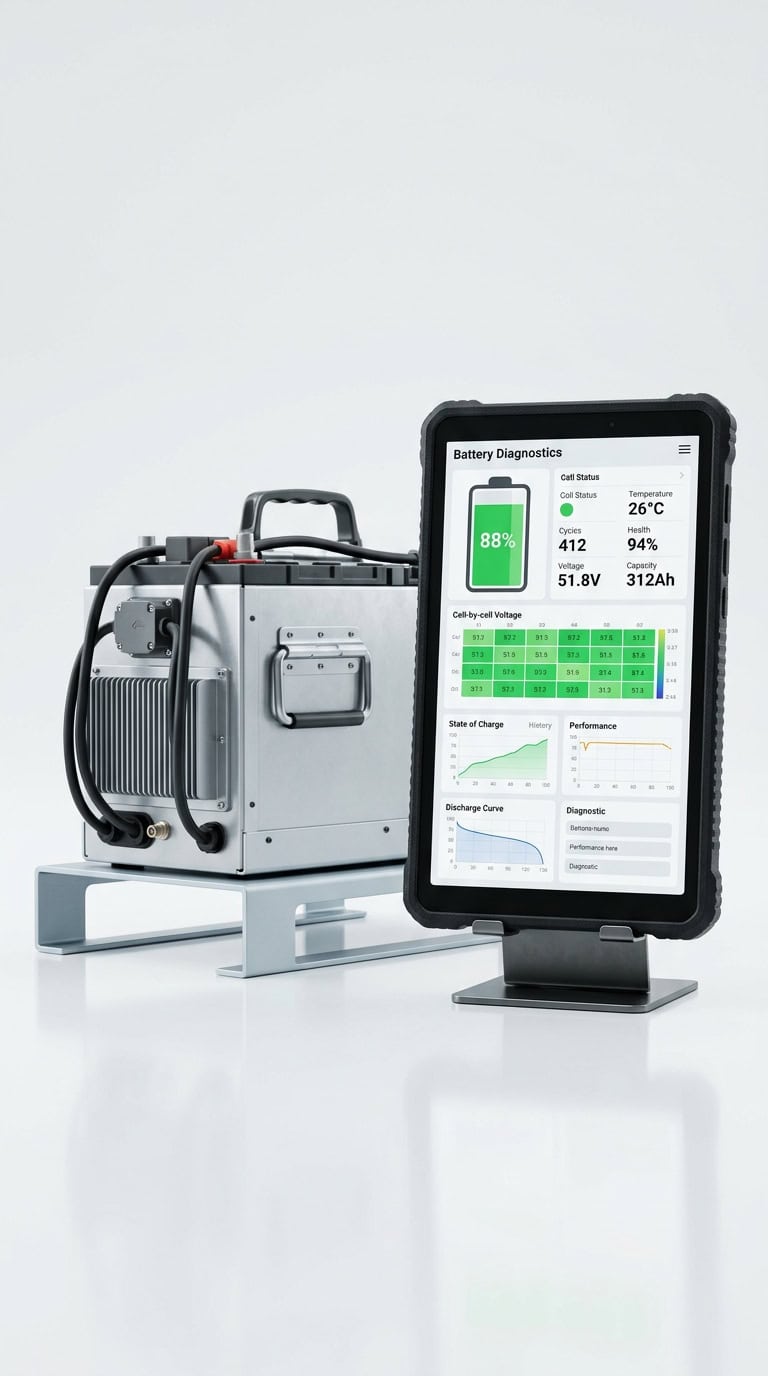
Cloud-based battery digital twins process multi-parameter fleet data to predict battery degradation, detect latent cell faults, and optimize charging schedules before vehicle breakdowns occur:
- Electrochemical Equivalent Circuit Modeling (ECM): Cloud algorithms continuously fit real-time current-voltage transients ($I(t), V(t)$) during dynamic forklift acceleration and electronic regenerative braking pulses to estimate internal ohmic resistance ($R_0$) and polarization resistance ($R_1$): $$V_{terminal}(t) = OCV(SOC) – I(t) \cdot R_0 – V_{RC}(t)$$ As a battery ages, micro-structural active material loss causes $R_0$ to rise. Tracking $R_0$ drift over months delivers true electrochemical State of Health ($SOH_R = R_{new} / R_{current}$) accurate to within $\pm 2.5\%$.
- Coulombic Efficiency & Micro-Short Detection: By analyzing continuous Ah integration during complete charge-discharge cycles, cloud machine learning models identify anomalous capacity divergences across paralleled cell strings. A single cell exhibiting abnormal self-discharge ($dV/dt$) during overnight rest periods is flagged as an internal micro-dendrite hazard weeks before thermal runaway can occur.
- Dynamic Fleet Opportunity Charging Dispatch: Cloud telematics algorithms monitor instantaneous fleet SOC, predicting which trucks will exhaust power during upcoming peak dispatch shifts. Automated commands direct specific vehicles to available fast chargers, leveling substation electrical peak demand while guaranteeing 100% mission availability.
5. ZOSPOWER Cloud-Connected Fleet Electrification Ecosystem
ZOSPOWER delivers a fully integrated, cloud-native industrial power ecosystem engineered to maximize fleet uptime, streamline warranty tracking, and lower operating costs:
- Factory-Integrated IoT Telematics Hardware: Every heavy-duty ZOSPOWER LiFePO4 battery pack can be ordered with a factory-integrated edge gateway, pre-wired into the internal BMS and antenna array with zero external harnesses required.
- Enterprise Cloud Dashboard & RESTful API: Fleet managers gain real-time visibility into vehicle locations, instantaneous energy consumption (kWh), operator driving aggression scores, and charging cycle histories. Open REST APIs and Webhooks integrate seamlessly with plant ERP and Warehouse Management Systems (WMS).
- Automated Firmware-Over-the-Air (FOTA): Enables secure, remote deployment of updated BMS protection algorithms, cell balancing calibrations, and charging profile enhancements across hundreds of deployed vehicles simultaneously without field technician site visits.
Transform Your Fleet Operations with ZOSPOWER Intelligence
Unlocking the full productivity of electric material handling fleets requires cutting-edge battery electrochemistry unified with deterministic IoT telematics and cloud predictive analytics.
Contact our industrial telematics engineering team today to review gateway hardware integration, request API documentation, and explore custom cloud-connected lithium battery solutions for your fleet.