Industrial Forklift Battery Charger Sizing & Selection: The Complete Engineering Guide
The performance, shift endurance, and operating lifespan of an electric forklift battery depend heavily on the quality of its charging system. Using an mismatched or inefficient industrial charger leads to chronic undercharging (sulfation), overcharging (thermal dry-out), and excessive power consumption.
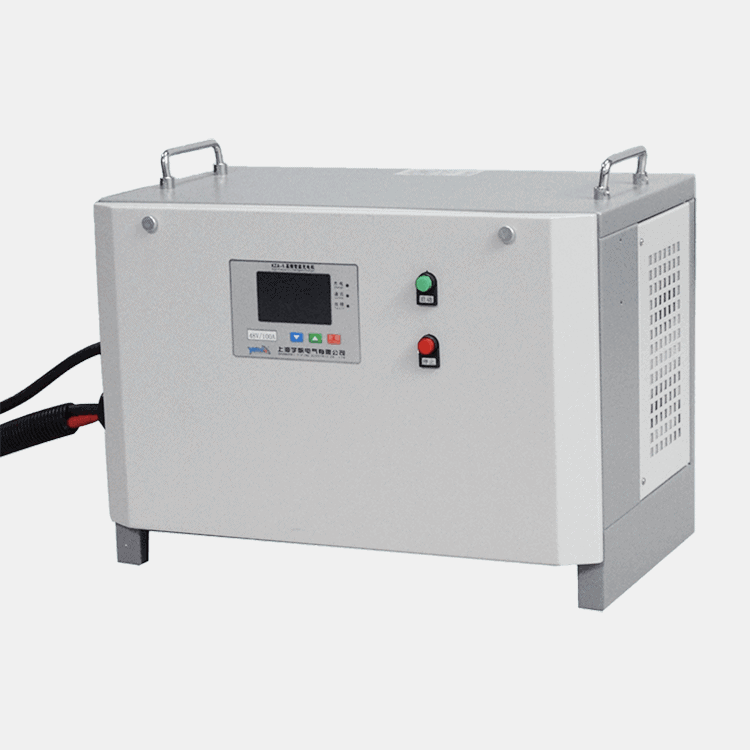
With advancements in modern power electronics, High-Frequency (HF) smart chargers are rapidly replacing legacy ferroresonant and silicon-controlled rectifier (SCR) chargers.
This comprehensive guide breaks down the essential criteria for sizing, selecting, and maintaining the right battery charger for your electric forklift fleet.
1. High-Frequency (HF) vs Traditional Ferroresonant / SCR Chargers
Understanding the technology behind your charger is the first step toward optimizing fleet efficiency:
| Feature / Metric | High-Frequency (HF) Smart Charger | Legacy Ferroresonant / SCR Charger |
|---|---|---|
| Power Conversion Efficiency | 92% – 95% (Low energy loss) | 70% – 80% (Significant heat dissipation) |
| Charging Profile Control | Programmable Microprocessor (Multi-curve) | Fixed analog transformer curve |
| Battery Chemistry Support | Lithium (LiFePO4) & Lead-Acid (PzS/PzB) | Wet Lead-Acid only |
| Opportunity / Fast Charge | Fully supported (High current modulation) | Not supported (Overheats battery) |
| Weight & Physical Footprint | Compact & Lightweight (10–25 kg, Wall-mountable) | Bulky & Heavy (80–180 kg, Floor stand) |
| Grid Power Factor (PF) | ≥ 0.98 (Integrated Active PFC) | ~0.70 – 0.80 (High reactive power draw) |
2. The 4 Essential Steps to Size a Forklift Battery Charger
`mermaid
graph TD
A[“Step 1: Match Nominal Voltage (24V / 36V / 48V / 72V / 80V)”] –> B[“Step 2: Calculate Output Current (Amps) based on Ah Capacity”]
B –> C[“Step 3: Verify Chemistry Profile (CC/CV for Lithium vs IUIa for Lead-Acid)”]
C –> D[“Step 4: Check Facility AC Input Power (Single-Phase vs 3-Phase 380V/480V)”]
`
Step 1: Match the DC Output Voltage
Always match the charger’s rated DC output voltage precisely to the battery pack’s nominal voltage:
Step 2: Determine the Optimal Charging Current (Amperage)
600Ah × 18-20% = 108-120A).Step 3: Match the Charging Profile & Communication Protocols
Step 4: Facility Electrical Input Verification
Ensure your warehouse electrical panel supports the charger’s input requirements:
3. Essential Safety & Protection Features to Require
When procuring industrial chargers for harsh warehouse environments, ensure the unit is certified with comprehensive hardware protection:
1. Active Thermal Compensation & Over-Temperature Protection: Automatic current derating when ambient temperatures exceed 45°C.
2. Reverse Polarity & Short-Circuit Protection: Solid-state arc suppression preventing damage if connectors are mismatched.
3. Over-Voltage & Over-Charge Safety Cutoff: Automatic timer-based and voltage-slope ($\Delta V / \Delta t$) termination.
4. IP Rating & Enclosure Durability: Heavy-gauge powder-coated steel chassis rated at minimum IP21 / IP54 for dust and splash resistance.
4. Frequently Asked Questions (FAQ)
Q1: Can one charger handle both 24V and 48V forklift batteries?
Multi-voltage smart chargers (e.g., ZOSPOWER 24V–80V universal series) automatically detect the connected battery’s nominal voltage and adjust their output parameters accordingly, provided the connector pinout and protocol match. Explore our 24V-80V Multi-Voltage Intelligent Charger for mixed fleets.
Q2: What causes a forklift charger to overheat?
Common causes include restricted ventilation louvers, accumulated airborne dust on cooling fans/heatsinks, undersized AC supply wiring causing voltage drops, or attempting to charge a severely defective/sulfated battery pack.
Q3: How much electricity can an HF smart charger save annually?
Upgrading from a 75% efficient legacy SCR charger to a 94% efficient ZOSPOWER high-frequency charger saves approximately 1,500 to 2,500 kWh per forklift per year, translating to direct utility savings of $200 to $400+ per truck annually.
5. Explore ZOSPOWER High-Efficiency Industrial Chargers
ZOSPOWER manufactures a complete lineup of CE-certified, high-frequency smart chargers ranging from 24V 30A portable modules to 80V 200A fast-charging stations compatible with both lithium and lead-acid motive power.
For professional charger sizing and custom connector wiring (REMA / Anderson), contact our technical specialists at [email protected] or explore our Battery Charger Catalog.
Need Expert Sizing for Your Industrial Forklift Battery Chargers?
Whether you require high-efficiency chargers for your existing lead-acid traction batteries or rapid-charging systems for new retrofitted LiFePO4 packs, our engineering team will size the exact amperage, voltage, and plug type for your facility.