Industrial Forklift Battery Maintenance: The Complete Daily, Weekly, and Charging Guide
In material handling and warehouse operations, the motive battery represents up to 30% of an electric forklift’s total asset value. Proper battery maintenance directly prevents unexpected downtime, mitigates early cell degradation, and maximizes operating ROI.
Whether your fleet relies on traditional tubular lead-acid traction batteries or modern lithium-ion (LiFePO4) systems, adhering to standardized maintenance protocols is essential for operational safety and longevity.
1. Daily Inspection & Operating Best Practices
Before starting each shift, forklift operators should perform a 2-minute visual and mechanical inspection:
1. Connector & Cable Integrity: Check power cables for frayed insulation, exposed copper, or cracked connector housings (e.g., REMA/Anderson connectors). Loose connections cause localized heating and voltage drop.
2. Terminal Corrosion Check: Inspect post terminals for white or greenish lead sulfate deposits. Clean corroded terminals using a wire brush and a neutralized baking soda solution (bicarbonate of soda).
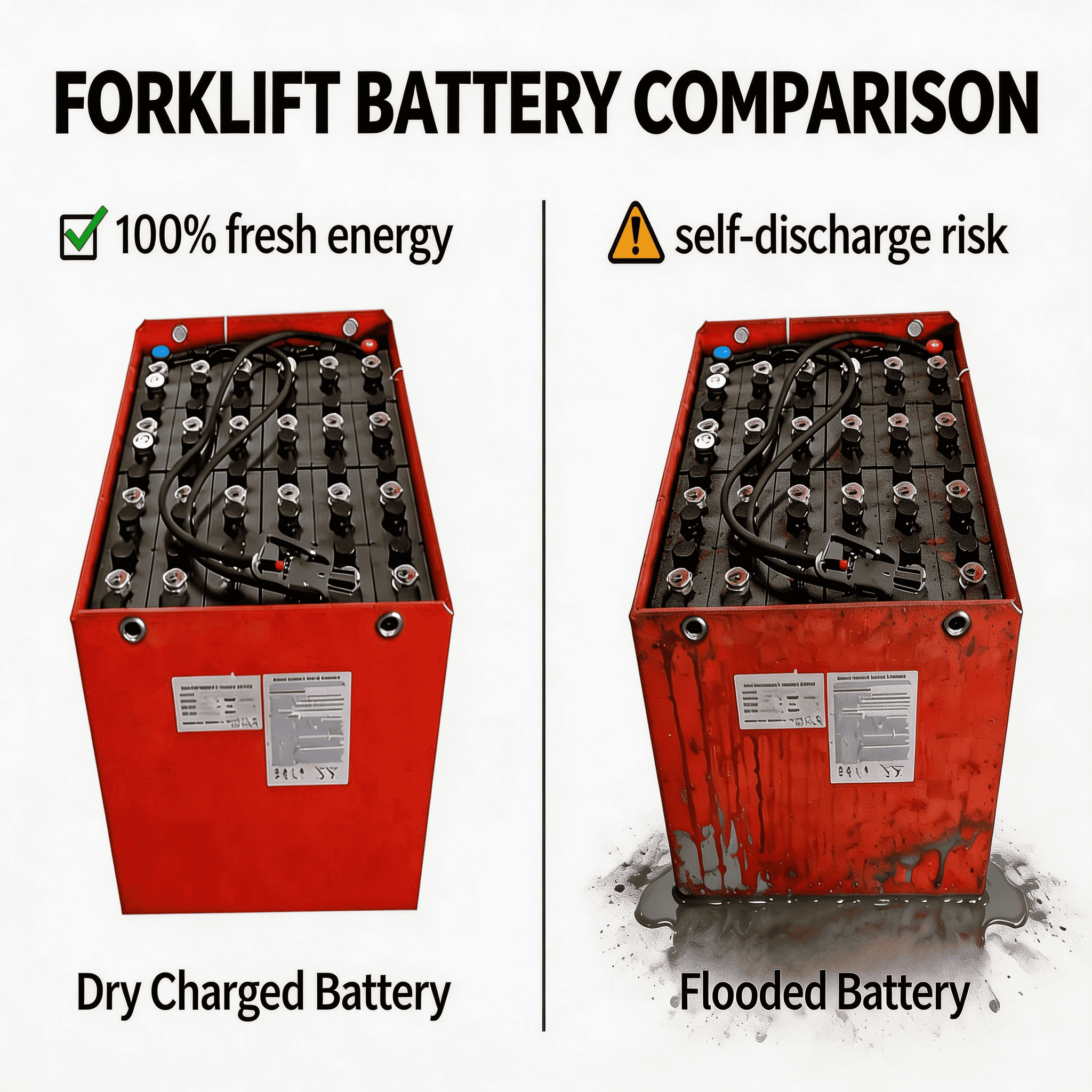
3. Tray & Enclosure Cleanliness: Keep the top of the battery clean and dry. Accumulated acid mist and moisture create parasitic discharge paths between cells, resulting in self-discharge.
4. Avoid Deep Discharging: Never discharge a traction lead-acid battery below 20% state of charge (80% Depth of Discharge – DoD). Deep discharging causes irreversible sulfation and accelerated active material shedding.
2. Proper Battery Watering Procedures (Lead-Acid Traction Batteries)
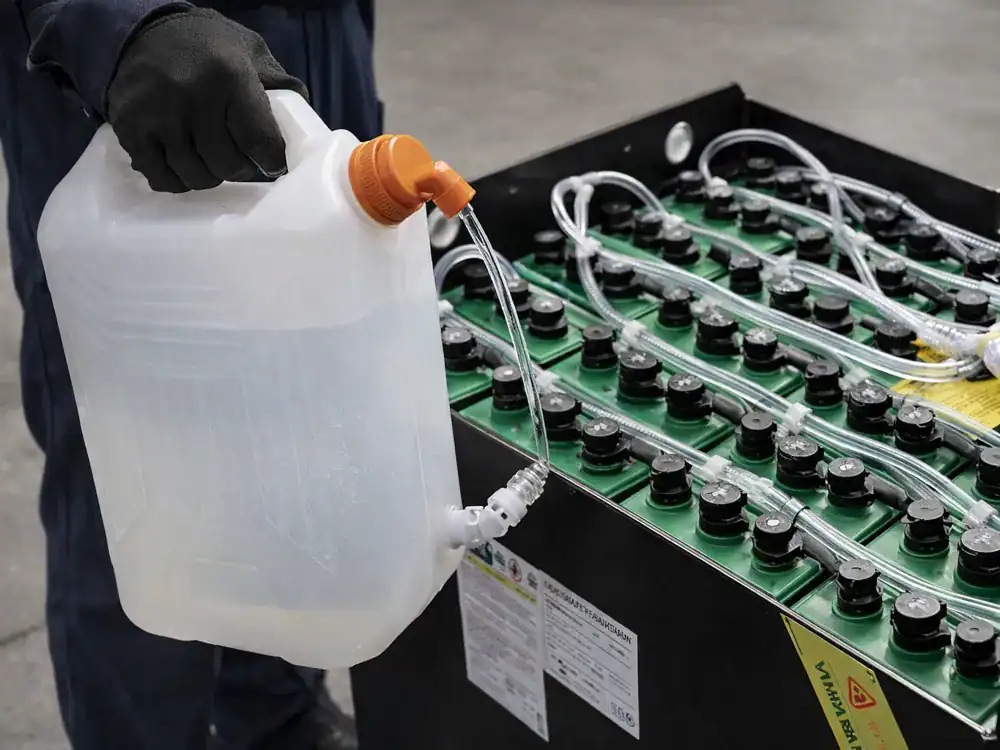
Watering is the single most critical maintenance task for wet-cell lead-acid batteries. Incorrect timing or water quality is the leading cause of premature failure.
| Parameter | Recommended Standard | Common Mistake / Hazard |
|---|---|---|
| Watering Timing | Only AFTER a complete charge cycle (when electrolyte has expanded). | Watering before charging causes acid overflow during gassing phase. |
| Water Quality | Deionized or distilled water only (Conductivity < 10 µS/cm). | Using tap water introduces minerals (iron, chlorine) that poison battery plates. |
| Electrolyte Level | 6–10 mm above the plastic separator splash guard. | Overfilling dilutes acid; underfilling exposes plates to oxidation and dry-out. |
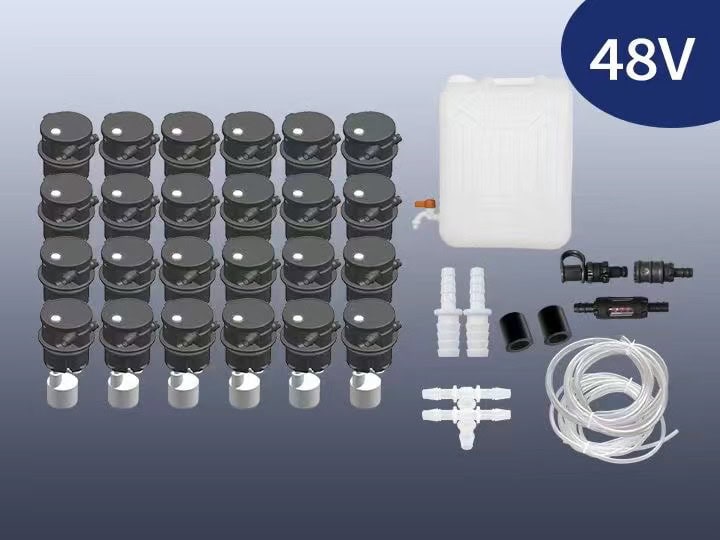
| Automation | Use single-point automatic watering systems and battery parts for fleet consistency. | Manual filling with uneven cell levels across 24V/48V/80V packs. |
3. Standard Charging Protocol & Equalization
A. The 8-8-8 Rule for Lead-Acid Batteries
Traditional motive power management relies on the standard cycle:
Operating a lead-acid battery without adequate cooling causes internal temperatures to exceed 45°C (113°F), drastically accelerating plate corrosion.
B. Equalization Charging (Bi-Weekly / Monthly)
Lead-acid cells inevitably develop slight variations in specific gravity and cell voltage over repeated cycles. An equalizing charge (a controlled 3–5 hour low-current overcharge) balances all individual cells, mixes stratified electrolyte, and dissolves hardened sulfate crystals.
C. Opportunity Charging: Lithium (LiFePO4) vs Lead-Acid
4. Key Differences: Lithium (LiFePO4) vs Lead-Acid Maintenance
| Maintenance Item | Lead-Acid Traction Battery | Lithium-Ion (LiFePO4) Battery |
|---|---|---|
| Watering Needs | Weekly to bi-weekly distilled water topping | Zero maintenance (100% sealed) |
| Equalization Cycle | Required every 5–10 charge cycles | Automated real-time balancing via BMS |
| Dedicated Battery Room | Required (Hydrogen gas ventilation & wash station) | Not required (Charge anywhere in facility) |
| Acid Spill Hazard | Risk of sulfuric acid leaks and corrosion | Zero acid / Zero hazardous gas emission |
| Expected Cycle Life | 1,200–1,500 cycles (to 80% DoD) | 3,500–5,000+ cycles (to 80% DoD) |
5. Essential Safety Guidelines for Battery Handling
Industrial forklift batteries weigh between 500 kg and 2,500 kg and contain hazardous electrical and chemical energy:
6. Summary: Maximize Your Fleet Power with ZOSPOWER
Consistent preventive maintenance preserves forklift battery capacity, lowers energy consumption, and protects your warehouse operations from costly downtime. If your fleet is transitioning from high-maintenance lead-acid packs to high-efficiency lithium power, ZOSPOWER provides drop-in replacement LiFePO4 battery packs engineered to your exact truck specifications.
For expert technical advice or custom battery sizing, contact our engineering team at [email protected] or visit https://zospower.com.
Looking to Optimize Your Fleet’s Battery Maintenance & Performance?
Whether you need heavy-duty PzS/PzB lead-acid traction batteries, automated watering kits, or a complete transition to drop-in lithium power, ZOSPOWER engineers provide custom technical sizing and fleet audits.