Operating industrial material handling equipment across punishing climate extremes—from blast freezing cold chain corridors (-30°C) to sun-baked tarmac and heavy foundry bays (+60°C)—places immense thermal stress on traction battery electrochemistry. Lithium Iron Phosphate (LiFePO4) prismatic cells achieve maximum cycle life, energy efficiency, and safety within an optimal thermal envelope between 15°C and 35°C. Attempting to rapid-charge cold cells below freezing induces catastrophic lithium metal plating and dendrite formation, while unchecked high-temperature operation accelerates solid electrolyte interphase (SEI) growth and risks cascading thermal runaway. This engineering guide evaluates PTC self-heating blankets versus liquid cooling plate architectures, details BMS closed-loop thermal algorithms, and outlines multi-layer physical runaway mitigation protocols essential for industrial fleet reliability.
1. Electrochemical Temperature Boundaries: Plating vs Degradation
Unlike internal combustion engines which utilize continuous liquid coolant loops, heavy-duty forklift traction packs operate as dense electrochemical cores. The temperature of the cell matrix dictates internal kinetic reaction rates:
- Sub-Zero Freezing Regime (< 0°C): Electrolyte viscosity surges, throttling lithium-ion diffusion within graphite anode intercalation channels. Forcing charging current into frozen cells causes lithium ions to deposit on the anode surface as metallic lithium plating, permanently destroying cell capacity and creating microscopic needle-like dendrites that puncture the separator, inducing internal short circuits.
- Optimal Operating Zone (15°C to 35°C): Coulombic efficiency exceeds 99%, internal DC resistance sits at design minimums (< 0.5 mΩ), and chemical side-reactions remain negligible.
- Elevated Thermal Regime (> 45°C): High ambient temperatures combined with continuous 1.0C–1.5C fast charging and heavy hydraulic lifting (Hydraulic Power Matching Guide) cause parasitic decomposition of the organic carbonate solvent, thickening the SEI layer and accelerating capacity fade.
| Thermal Management Architecture | Passive Natural Air Convection | Silicon PTC Self-Heating Matrix | Active Chiller Liquid Cooling Plates |
|---|---|---|---|
| Sub-Zero Charging Capability | Strictly prohibited (< 0°C lockout) | Rapid automated pre-heating to +5°C | Pre-heats via reverse heat pump loop |
| High-Ambient Heat Dissipation | Poor (Trapped inside steel enclosure) | Thermal buffer insulation only | Active liquid heat extraction (> 5 kW) |
| Core-to-Surface Thermal Delta | High (ΔT > 12°C between cells) | Controlled (ΔT < 4°C via heat spreaders) | Ultra-uniform (ΔT < 2.5°C across pack) |
| System Complexity & Weight | Low (Bare steel battery bay) | Low (Integrated internal silicone pads) | Moderate (Cooling lines, radiator, pump) |
| Primary Fleet Application | Light indoor dry ambient warehouses | Cold storage, freezers & outdoor yards | Heavy foundries, ports & 3-shift fast-charge |
2. Sub-Zero Engineering: Dual-Zone PTC Heating & Pre-Charge Logic
In cold chain logistics hubs operating at -25°C (Cold Chain Electrification Guide), Zospower incorporates high-density Positive Temperature Coefficient (PTC) silicone heating blankets laminated between prismatic cell modules and aluminum heat-spreading baseplates:
PTC heating materials possess an inherent physical safety feature: electrical resistance increases exponentially as temperature rises, preventing localized hot spots. When an operator connects a frozen battery to an Industrial High-Frequency Charger, the BMS initiates an automated closed-loop warming sequence:
- Charging Current Redirection: The BMS opens the primary charging contactor to isolate the cold cell matrix, routing 100% of initial incoming charger DC power exclusively to the internal PTC heating pads.
- Vacuum Aerogel Thermal Containment: Composite aerogel insulation lining the 8mm structural steel enclosure minimizes thermal transfer to exterior -30°C freezer air.
- Automated Cut-In Handshake: Multiple NTC thermistors monitor core cell temperatures. Once internal cell temperatures uniformly exceed +5°C, the BMS closes the main battery contactors, ramping charging current smoothly to full 1.0C rate without lithium plating risk.
3. Liquid Cooling Plate Architecture for Heavy-Duty & Hot-Metal Operations
In ultra-heavy operating environments—such as steel mills (Steel Mill Forklift Electrification), port container handlers (Port Decarbonization Guide), and underground mining vehicles (Transición a los vehículos eléctricos en la minería subterránea)—continuous 400A–800A discharge pulses generate severe internal Joule heating that air cooling cannot remove.
Zospower deploys an automotive-grade extruded aluminum parallel-flow cold plate system:
- Low-Profile Bottom Cold Plates: Precision-milled aluminum cooling channels interface directly with prismatic cell bottoms via high-thermal-conductivity gap pads (> 3.5 W/m·K).
- Dielectric Glycol-Water Coolant: A 50/50 ethylene glycol and deionized water mixture circulates through an external automotive radiator or active chiller unit, maintaining cell temperatures below 38°C even when working next to 60°C furnace slag.
- Pre-Charge Inrush Protection: Circulation pumps and cooling fans are softly staged using integrated pre-charge circuits (Pre-Charge Resistor Circuit Guide) to prevent electrical spikes.
4. Physical Thermal Runaway Mitigation & Directional Venting
While Lithium Iron Phosphate (LiFePO4) is fundamentally the safest lithium chemistry on earth—with cathode decomposition occurring at 270°C compared to volatile ternary NMC which violently decomposes at 150°C—extreme mechanical crushing or severe electrical abuse can generate internal cell gassing.
Zospower industrial enclosures integrate a 3-layer passive safety barrier:
- Inter-Cell Micro-Porous Aerogel Barriers: Thin 1.5mm ceramic-fiber aerogel blankets separate each individual series cell. If a single cell experiences an internal fault, the barrier blocks heat conduction (> 1,000°C withstand), completely preventing thermal cascade propagation to adjacent cells.
- Directional Pressure Relief Manifold: Each cell incorporates an individual laser-notched burst vent. Cell off-gassing is channeled into a dedicated internal stainless steel manifold that directs hot gases away from vehicle electronics toward an external flame-arresting breather valve conforming to ATEX Explosion-Proof Standards.
- Galvanic Isolation & Sensor Protection: Thermal sensing thermistors pass through isolated barriers to ensure ground fault integrity as outlined in our Insulation Resistance & Ground Fault Guide.
5. BMS Algorithmic Thermal Derating & Active Cell Balancing Integration
Thermal management is inherently linked to battery electronics. The master BMS executes continuous thermal gradient monitoring across dozens of multi-point digital thermistors:
- Proportional Thermal Derating: As battery core temperature approaches 50°C, the BMS transmits dynamic charge current limit (DCCL) commands over CANopen / J1939 to the drive controller, smoothly tapering maximum current to protect cell longevity.
- Harmonized Active Balancing: Because warmer cells exhibit higher electrochemical activity, active cell balancing (Active vs Passive Cell Balancing Guide) dynamically redistributes charge across series strings, preventing thermal hot-spot divergence.
- Cloud Telematics Alarms: Live temperature heat maps are streamed in real time to fleet dispatchers via our Sistema de telemática e IoT para flotas de BMS.
6. Field Maintenance Checklist for Battery Thermal Systems
When conducting scheduled preventive maintenance on industrial lithium fleets, field service technicians should follow this inspection protocol:
- Perform Infrared Thermographic Scan: Under full-rated mast lift load, capture an IR thermal image of the battery terminal lugs, main contactor tips, and shunt sensor (Current Shunt Calibration Guide). Temperature variance across terminals must remain < 5°C.
- Verify PTC Heating Blanket Resistance: Measure resistance across the heating power pins to confirm heating elements are intact before winter freezer deployments.
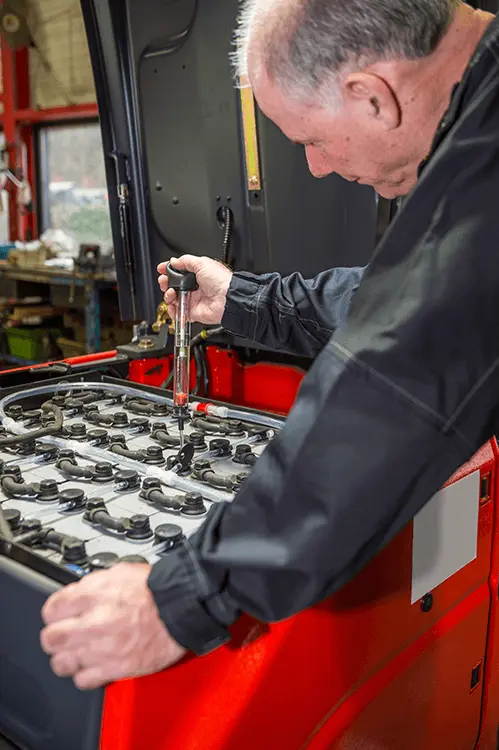
- Check Coolant Specific Gravity & Level: For liquid-cooled packs, verify glycol concentration using an optical refractometer and inspect quick-disconnect dry-break fittings for leaks.
- Pair with Smart High-Frequency Chargers: Ensure chargers support temperature-compensated charging profiles as documented in our Guía para la selección de cargadores de carretillas elevadoras.
Conquer Temperature Extremes with Zospower Thermal-Engineered Lithium
Are sub-zero freezer runtimes or desert summer heat waves degrading your forklift battery life and triggering unexpected thermal shutdowns? Zospower manufactures industrial-grade Batería de LiFePO4 systems equipped with automated dual-zone PTC self-heating, liquid cooling cold plates, and certified thermal runaway containment.
Contact our senior thermal systems engineering team today to review your ambient temperature envelopes, obtain custom CAD heating layouts, and maximize your fleet’s all-weather uptime.