Understanding the Charging Backbone
Upgrading to an advanced forklift battery is only half the equation; the battery charger is equally critical. For decades, traditional SCR (Silicon Controlled Rectifier) or ferroresonant chargers dominated the industry. Today, High-Frequency (HF) chargers have taken over. Here is why the switch is mandatory for modern fleets.
The Legacy: SCR Chargers
SCR chargers are heavy, bulky, and rely on massive copper transformers to step down AC grid power to DC battery power. While they are incredibly durable, they suffer from terrible electrical efficiency—often hovering around 70%. This means 30% of the electricity you pay for is wasted as heat during the conversion process.
The Modern Standard: High-Frequency (HF) Chargers
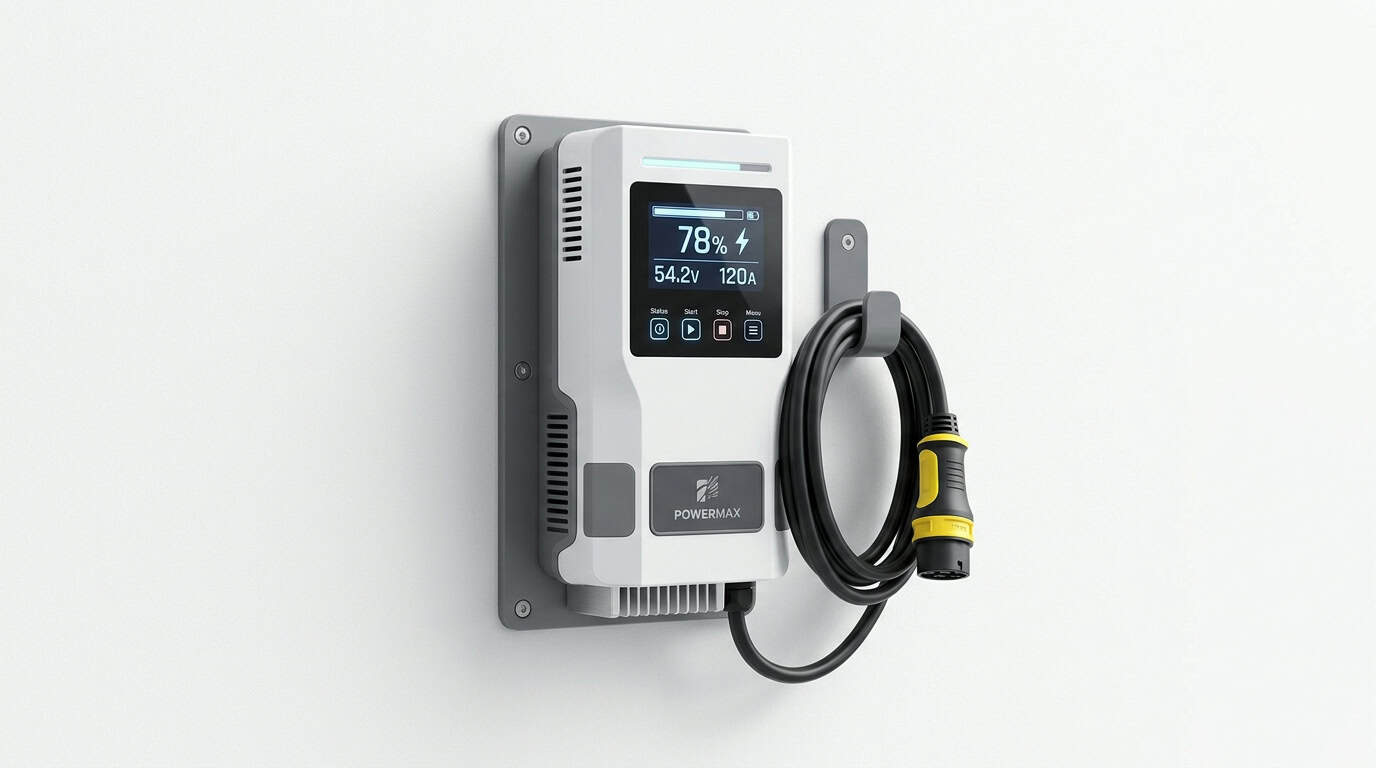
High-Frequency chargers use modern solid-state electronics to switch power thousands of times per second. This eliminates the need for massive transformers.
- Unmatched Efficiency: HF chargers routinely achieve 93% to 95% power conversion efficiency. For a large fleet, the reduction in electricity bills alone can pay for the charger within 18 months.
- Compact & Wall-Mountable: Because they lack heavy transformers, HF chargers are a fraction of the size and weight of SCR chargers. They can be easily mounted on warehouse walls, saving valuable floor space.
- Smart Multi-Voltage Charging: Modern HF chargers communicate directly with the battery’s BMS via CAN bus. They dynamically adjust their voltage and current profiles in real-time, allowing a single HF charger to safely charge both a 48V sit-down forklift and a 24V pallet jack simply by recognizing the battery’s BMS handshake.
ZOSPOWER HF Integration
All ZOSPOWER LiFePO4 batteries are paired with state-of-the-art HF chargers, enabling our signature 1-hour fast opportunity charging without overloading your facility’s electrical grid.