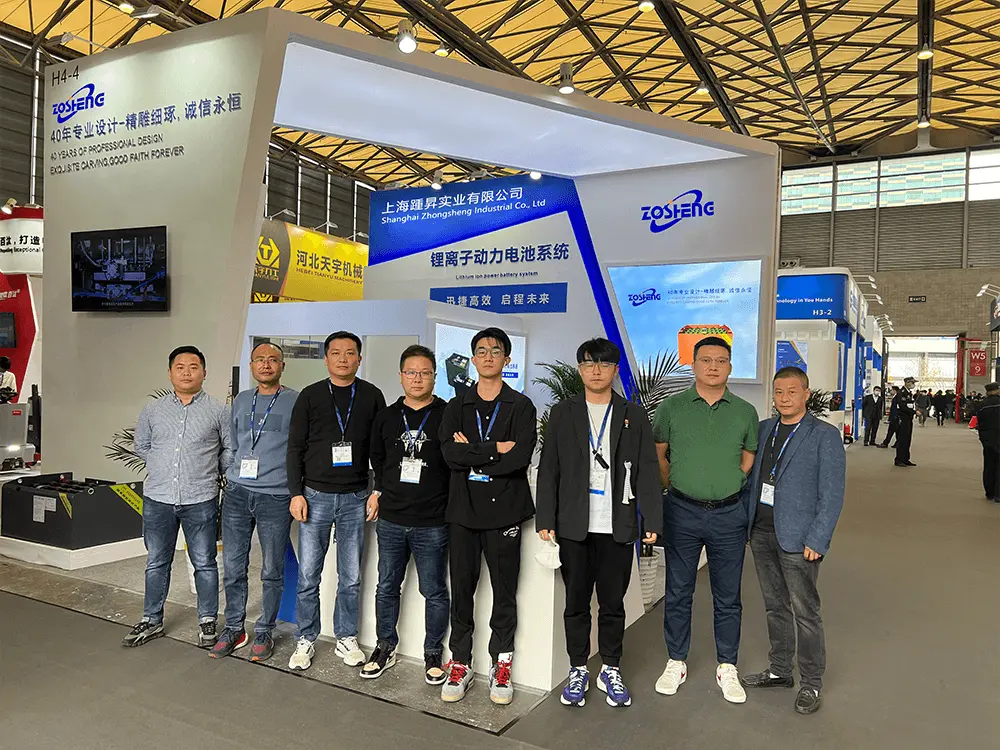
As commercial industrial real estate costs escalate and global supply chains demand maximum volumetric density, modern distribution centers are moving upward. High-bay automated fulfillment facilities and Very Narrow Aisle (VNA) racking systems—elevating unit loads up to 14 to 18 meters in ultra-tight 1.6-meter aisles—have become the benchmark for logistics efficiency. However, operating turret trucks, order pickers, and man-up VNA forklifts at extreme elevations introduces severe power constraints. Legacy flooded lead-acid batteries suffer from crippling voltage sags that destabilize mast lifting, while multi-step battery swapping creates operational gridlock in narrow wire-guided corridors. Custom-engineered high-voltage Lithium Iron Phosphate (LiFePO4) systems represent the definitive powertrain standard for next-generation vertical warehousing in 2026.
1. Dense Vertical Storage Dynamics & VNA Kinematics
In high-density racking configurations, conventional counterbalance forklifts requiring 3.5 to 4.0-meter aisles waste up to 60% of total facility footprint on floor traffic lanes. VNA turret trucks compress aisle width to less than 1.6 meters, increasing pallet storage capacity by up to 300% to 400% across identical building footprints.
However, the physics of VNA operation impose extreme duty-cycle demands on traction batteries:
- High-Lift Hydraulic Surge at 16+ Meters: Hoisting a 1.5-ton pallet to the top beam tier requires sustained hydraulic pump power for 30 to 45 seconds per cycle, drawing continuous currents between 350A and 550A on 80V bus architectures.
- Wire-Guidance & Magnetic Sensor Sensitivity: VNA trucks follow inductive floor wires or rail guides with millimeter precision. Voltage fluctuations and electromagnetic interference (EMI) from noisy battery circuits risk corrupting steering tracking sensors.
- Severe Mast Sway and Oscillation: When hydraulic pressure drops abruptly due to battery voltage sag, elevated masts experience violent sway, risking pallet collision with structural rack uprights.
| Performance Parameter | Flooded Lead-Acid (80V 600Ah) | Zospower VNA-Optimized LiFePO4 (80V 600Ah) | High-Bay Warehouse Impact |
|---|---|---|---|
| Voltage Stability @ Full Mast Height | Severe voltage sag (-12V drop @ 50% SOC) | Ultra-flat voltage plateau (< 2V drop) | Maintains constant lift speed up to 18 meters |
| Single-Shift Swapping Labor | 45–60 min/day (Trapped in narrow aisles) | Zero swapping (Opportunity charge in aisle) | Eliminates 1.5 hours wasted operator downtime daily |
| Floor Weight & Mast Ballast Precision | Loose acid sloshing alters center of gravity | Solid integrated cast ballast plates | Eliminates dynamic roll instability at high elevations |
| Aisle In-Feed Opportunity Charging | Impossible (Acid gas & thermal runaway risk) | Safe end-of-aisle 1C fast charging (15-min boost) | Enables continuous 24/7 three-shift rotations |
| Mast Lowering Energy Recovery | Wasted as hydraulic oil heat in tank | High pulse absorption reclaims 12% to 16% | Keeps hydraulic oil 15°C cooler; extends runtime |
2. The Aisle Gridlock: Why Lead-Acid Paralyzes VNA Operations
While lead-acid batteries can be swapped in wide-open staging areas, the geometry of a high-bay VNA warehouse makes battery changes an operational nightmare:
- Aisle Extraction Bottlenecks: When a VNA truck depletes its lead-acid battery, it must disengage from the floor guide wire, slowly creep out of a 100-meter-long aisle, and navigate to a centralized battery swap room. In busy fulfillment centers, this process blocks entire picking zones, stalling adjacent automated guided systems (AGV & AMR Automation Power Trends).
- Severe Low-Voltage Mast Lockout: As documented in our engineering analysis on Forklift Hydraulic Power Matching & Voltage Sag, once a lead-acid battery drops below 50% SOC, internal resistance spikes. Attempting to lift a heavy load to 14 meters triggers the truck’s low-voltage cutout, stranding the elevated carriage mid-air.
- Acid Mist in Enclosed High-Bay Air Columns: VNA high-bays feature vertical air stratification. Corrosive acid mist emitted by charging lead-acid packs rises to upper racking tiers, accelerating rust on high-tensile structural rack bolts and automated bar code scanners.
3. Zospower LiFePO4 Engineering for Premier VNA Trucks
Zospower designs heavy-duty, ultra-compact 80V LiFePO4 traction systems tailored specifically to drop into narrow OEM battery compartments of premier VNA manufacturers including Jungheinrich (EKX series), Linde (K series), Crown (TSP series), and Hyster/Yale:
- Solid Cast Ballast Plate Precision: VNA trucks require strictly calibrated minimum service weights (often 2,500 kg to 3,800 kg) to counterbalance elevated mast leverage. Zospower incorporates laser-cut solid structural steel ballast plates inside the battery casing, perfectly matching OEM center-of-gravity specifications (Jungheinrich VNA Retrofit Specs and Crown Forklift Retrofit Specs).
- High-Frequency Active Cell Balancing: High-voltage multi-series packs deploy bi-directional active balancing to eliminate cell divergence under continuous high-amperage hydraulic lifting, preserving 100% usable pack capacity over 4,000+ deep cycles.
- Advanced Pre-Charge Suppression Architecture: Integrated solid-state pre-charge circuits protect sophisticated MOSFET travel and lift controllers against destructive inrush spikes during start-up as detailed in our Pre-Charge Resistor Circuit Engineering Guide.
- Direct CAN Bus Handshake: Native integration with OEM chassis controllers continuously broadcasts dynamic charge current limits (DCCL) and instantaneous thermal state over CANopen / J1939 protocols via our BMS Telematics & IoT Fleet Monitoring System.
4. Aisle-End Opportunity Charging: Achieving 24/7 Autonomous Uptime
The strategic breakthrough for VNA operations is in-aisle or end-of-aisle opportunity fast charging. Instead of traveling to distant battery rooms, compact DC fast-charging pedestals (15 kW to 30 kW) are installed at the transfer staging zones at the end of each racking run.
During mandatory 15-minute operator breaks or 30-minute lunch shifts, the VNA truck connects to the high-efficiency charger. At a 1.0C charge rate, a 20-minute opportunity charge replenishes 30% to 35% state-of-charge. This allows a single VNA truck equipped with a single Zospower LiFePO4 battery to operate continuously across three full shifts (24 hours/day) without ever removing the battery from the chassis.
To eliminate transformer overloads when multiple VNA trucks plug in simultaneously, logistics hubs deploy Dynamic Load Balancing (DLB) Fast Charging to manage facility power draw intelligently.
5. 5-Year Financial ROI: Lead-Acid vs Zospower LiFePO4 in High-Bays
Below is an audited 5-year financial breakdown for an automated high-bay distribution center operating a fleet of 12 VNA Turret Trucks across a demanding 3-shift 24/7 schedule:
| 5-Year Expenditure Category (12 VNA Trucks) | Flooded Lead-Acid (2 Packs / Truck) | Zospower LiFePO4 (1 Pack / Truck) | 5-Year Financial Benefit |
|---|---|---|---|
| Battery & Charger Procurement | $264,000 (24 packs + 12 SCR chargers) | $340,000 (12 LiFePO4 + 6 fast chargers) | -$76,000 (Initial CapEx Premium) |
| Mid-Life Battery Replacement (Year 3) | $264,000 (Lead-acid degrades in 2.5 yrs) | $0 (LiFePO4 lasts 10+ years / 4,000 cycles) | +$264,000 Replacement Savings |
| Swapping & Watering Labor ($28/hr) | $306,600 (45 min/day/truck operator labor) | $0 (Zero swapping, zero watering) | +$306,600 Labor Savings |
| Electricity Consumption (AC Grid Draw) | $395,000 (Low 68% charging efficiency) | $245,000 (95% high-frequency efficiency) | +$150,000 Grid Energy Savings |
| Battery Room Real Estate Opportunity Cost | $120,000 (2,000 sq.ft high-bay storage lost) | $0 (Zero battery room needed) | +$120,000 Real Estate Savings |
| Total 5-Year Operating Cost | $1,349,600 | $585,000 | +$764,600 Net Savings |
The audited financial model demonstrates that converting 12 VNA turret trucks to Zospower LiFePO4 generates over $764,000 in net operational savings over five years, achieving full capital payback within 11 to 14 months while reclaiming 2,000 square feet of prime high-bay floor space for revenue-generating pallet racking.
6. Engineering Checklist for VNA Fleet Commissioning
Facility engineers planning a VNA lithium conversion should execute this 4-step engineering verification protocol:
- Verify Exact Counterweight Center of Gravity: Confirm battery overall mass and weight distribution with chassis CAD models to maintain structural stability at full 18-meter mast elevation.
- Audit CAN Bus Baud Rate Synchronization: Match the BMS CAN communication rate (125 kbps, 250 kbps, or 500 kbps) with the vehicle’s central PLC to ensure seamless travel and lift speed governance.
- Ensure Insulation Resistance Integrity: Verify floating DC bus isolation exceeds 500 Ω/V to prevent guidance sensor ground loops as outlined in our Insulation Resistance & Ground Fault Guide.
- Pair with High-Frequency Chargers: Deploy resonant high-frequency chargers equipped with dynamic CC/CV profiles as documented in our Forklift Charger Selection Guide.
Maximize Vertical High-Bay Productivity with Zospower VNA Lithium
Are voltage sags slowing your high-mast turret trucks and battery swaps creating warehouse aisle bottlenecks? Zospower manufactures custom-engineered, high-voltage 80V LiFePO4 battery systems tailored specifically for very narrow aisle (VNA) forklifts, high-rack order pickers, and automated high-bay warehouses.
Contact our vertical warehousing applications engineering team today to review your mast elevation profiles, obtain precision CAD ballast drawings, and calculate your fleet ROI payback.