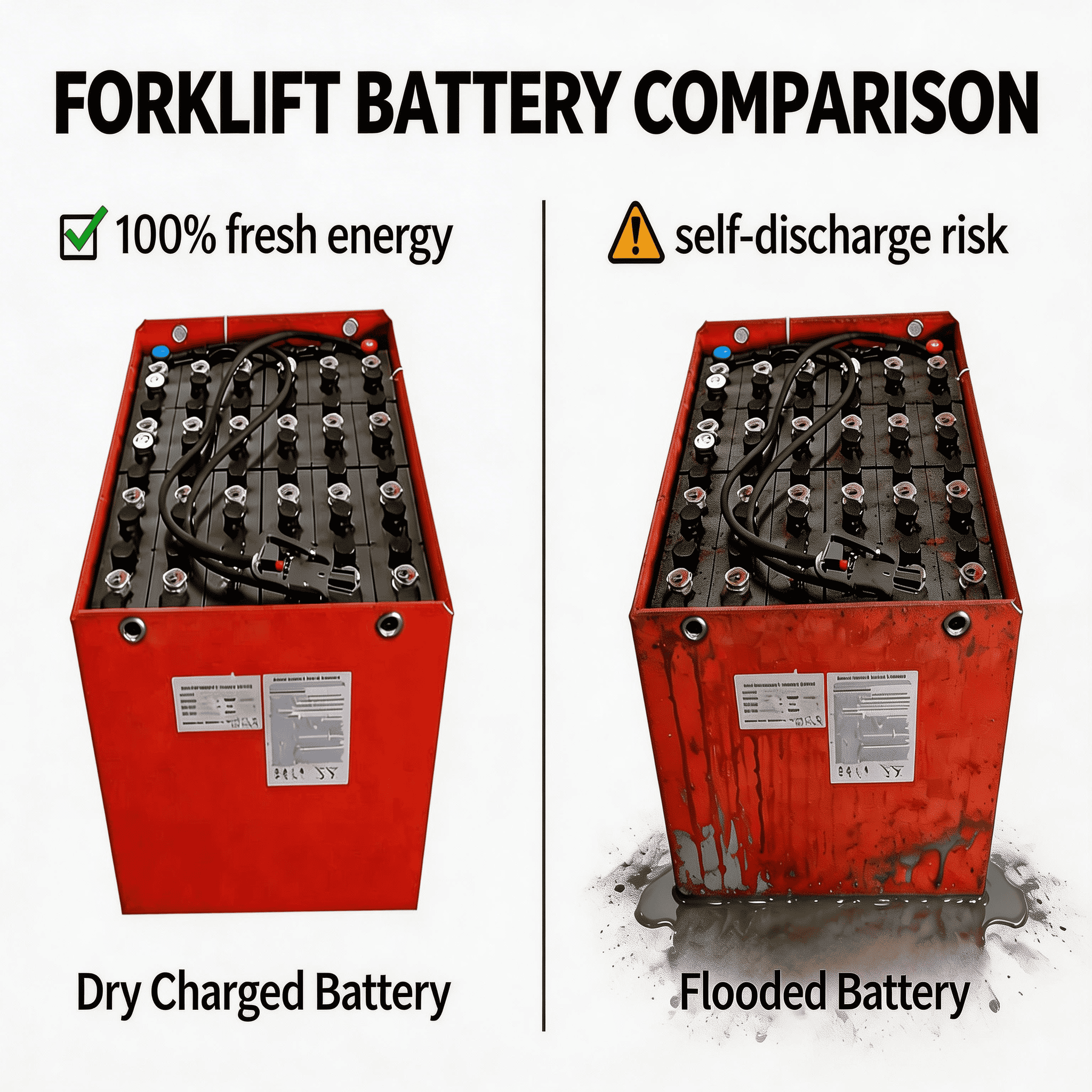
As commercial industrial real estate costs escalate and global supply chains demand maximum volumetric density, modern distribution centers are moving upward. High-bay automated fulfillment facilities and Very Narrow Aisle (VNA) racking systems—elevating unit loads up to 14 to 18 meters in ultra-tight 1.6-meter aisles—have become the benchmark for logistics efficiency. However, operating turret trucks, order pickers, and man-up VNA forklifts at extreme elevations introduces severe power constraints. Legacy flooded lead-acid batteries suffer from crippling voltage sags that destabilize mast lifting, while multi-step battery swapping creates operational gridlock in narrow wire-guided corridors. Custom-engineered high-voltage Lithium Iron Phosphate (LiFePO4) systems represent the definitive powertrain standard for next-generation vertical warehousing in 2026.
1. Dense Vertical Storage Dynamics & VNA Kinematics
In high-density racking configurations, conventional counterbalance forklifts requiring 3.5 to 4.0-meter aisles waste up to 60% of total facility footprint on floor traffic lanes. VNA turret trucks compress aisle width to less than 1.6 meters, increasing pallet storage capacity by up to 300% to 400% across identical building footprints.
However, the physics of VNA operation impose extreme duty-cycle demands on traction batteries:
- High-Lift Hydraulic Surge at 16+ Meters: Hoisting a 1.5-ton pallet to the top beam tier requires sustained hydraulic pump power for 30 to 45 seconds per cycle, drawing continuous currents between 350A and 550A on 80V bus architectures.
- Wire-Guidance & Magnetic Sensor Sensitivity: VNA trucks follow inductive floor wires or rail guides with millimeter precision. Voltage fluctuations and electromagnetic interference (EMI) from noisy battery circuits risk corrupting steering tracking sensors.
- Severe Mast Sway and Oscillation: When hydraulic pressure drops abruptly due to battery voltage sag, elevated masts experience violent sway, risking pallet collision with structural rack uprights.
| 性能パラメータ | Flooded Lead-Acid (80V 600Ah) | Zospower VNA-Optimized LiFePO4 (80V 600Ah) | High-Bay Warehouse Impact |
|---|---|---|---|
| Voltage Stability @ Full Mast Height | Severe voltage sag (-12V drop @ 50% SOC) | Ultra-flat voltage plateau (< 2V drop) | Maintains constant lift speed up to 18 meters |
| Single-Shift Swapping Labor | 45–60 min/day (Trapped in narrow aisles) | Zero swapping (Opportunity charge in aisle) | Eliminates 1.5 hours wasted operator downtime daily |
| Floor Weight & Mast Ballast Precision | Loose acid sloshing alters center of gravity | Solid integrated cast ballast plates | Eliminates dynamic roll instability at high elevations |
| Aisle In-Feed Opportunity Charging | Impossible (Acid gas & thermal runaway risk) | Safe end-of-aisle 1C fast charging (15-min boost) | Enables continuous 24/7 three-shift rotations |
| Mast Lowering Energy Recovery | Wasted as hydraulic oil heat in tank | High pulse absorption reclaims 12% to 16% | Keeps hydraulic oil 15°C cooler; extends runtime |
2. The Aisle Gridlock: Why Lead-Acid Paralyzes VNA Operations
While lead-acid batteries can be swapped in wide-open staging areas, the geometry of a high-bay VNA warehouse makes battery changes an operational nightmare:
- Aisle Extraction Bottlenecks: When a VNA truck depletes its lead-acid battery, it must disengage from the floor guide wire, slowly creep out of a 100-meter-long aisle, and navigate to a centralized battery swap room. In busy fulfillment centers, this process blocks entire picking zones, stalling adjacent automated guided systems (AGV & AMR Automation Power Trends).
- Severe Low-Voltage Mast Lockout: As documented in our engineering analysis on Forklift Hydraulic Power Matching & Voltage Sag, once a lead-acid battery drops below 50% SOC, internal resistance spikes. Attempting to lift a heavy load to 14 meters triggers the truck’s low-voltage cutout, stranding the elevated carriage mid-air.
- Acid Mist in Enclosed High-Bay Air Columns: VNA high-bays feature vertical air stratification. Corrosive acid mist emitted by charging lead-acid packs rises to upper racking tiers, accelerating rust on high-tensile structural rack bolts and automated bar code scanners.
3. Zospower LiFePO4 Engineering for Premier VNA Trucks
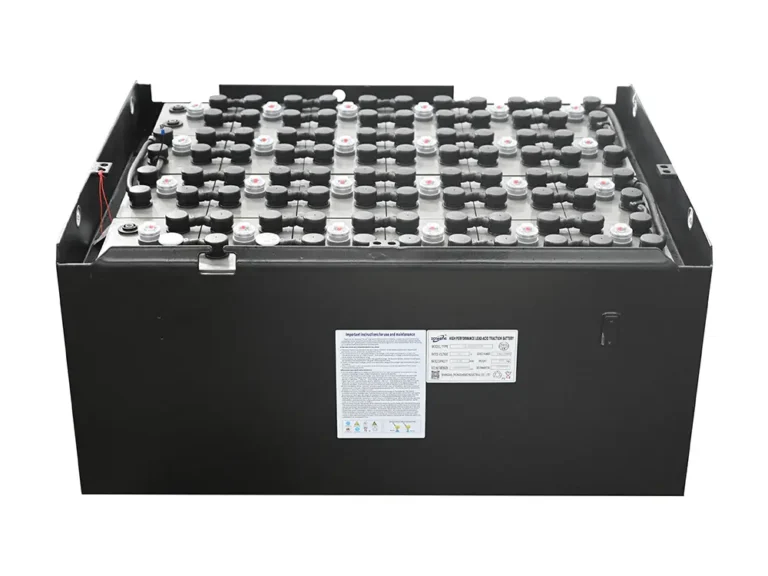
Zospower designs heavy-duty, ultra-compact 80V LiFePO4 traction systems tailored specifically to drop into narrow OEM battery compartments of premier VNA manufacturers including Jungheinrich (EKX series), Linde (K series), Crown (TSP series), and Hyster/Yale:
- Solid Cast Ballast Plate Precision: VNA trucks require strictly calibrated minimum service weights (often 2,500 kg to 3,800 kg) to counterbalance elevated mast leverage. Zospower incorporates laser-cut solid structural steel ballast plates inside the battery casing, perfectly matching OEM center-of-gravity specifications (Jungheinrich VNA Retrofit Specs そして Crown Forklift Retrofit Specs).
- High-Frequency Active Cell Balancing: High-voltage multi-series packs deploy bi-directional active balancing to eliminate cell divergence under continuous high-amperage hydraulic lifting, preserving 100% usable pack capacity over 4,000+ deep cycles.
- Advanced Pre-Charge Suppression Architecture: Integrated solid-state pre-charge circuits protect sophisticated MOSFET travel and lift controllers against destructive inrush spikes during start-up as detailed in our Pre-Charge Resistor Circuit Engineering Guide.
- Direct CAN Bus Handshake: Native integration with OEM chassis controllers continuously broadcasts dynamic charge current limits (DCCL) and instantaneous thermal state over CANopen / J1939 protocols via our BMS テレマティクス&IoT 車両管理システム.
4. Aisle-End Opportunity Charging: Achieving 24/7 Autonomous Uptime
The strategic breakthrough for VNA operations is in-aisle or end-of-aisle opportunity fast charging. Instead of traveling to distant battery rooms, compact DC fast-charging pedestals (15 kW to 30 kW) are installed at the transfer staging zones at the end of each racking run.
During mandatory 15-minute operator breaks or 30-minute lunch shifts, the VNA truck connects to the high-efficiency charger. At a 1.0C charge rate, a 20-minute opportunity charge replenishes 30% to 35% state-of-charge. This allows a single VNA truck equipped with a single Zospower LiFePO4電池 to operate continuously across three full shifts (24 hours/day) without ever removing the battery from the chassis.
To eliminate transformer overloads when multiple VNA trucks plug in simultaneously, logistics hubs deploy 動的負荷分散(DLB)による急速充電 to manage facility power draw intelligently.
5. 5-Year Financial ROI: Lead-Acid vs Zospower LiFePO4 in High-Bays
Below is an audited 5-year financial breakdown for an automated high-bay distribution center operating a fleet of 12 VNA Turret Trucks across a demanding 3-shift 24/7 schedule:
| 5-Year Expenditure Category (12 VNA Trucks) | 液式鉛蓄電池(2パック/トラック) | Zospower LiFePO4(1パック/トラック) | 5-Year Financial Benefit |
|---|---|---|---|
| Battery & Charger Procurement | $264,000 (24 packs + 12 SCR chargers) | $340,000 (12 LiFePO4 + 6 fast chargers) | -$76,000 (Initial CapEx Premium) |
| Mid-Life Battery Replacement (Year 3) | $264,000 (Lead-acid degrades in 2.5 yrs) | $0(LiFePO4は10年以上/4,000サイクル持続) | +$264,000 Replacement Savings |
| Swapping & Watering Labor ($28/hr) | $306,600 (45 min/day/truck operator labor) | $0(土壌の入れ替えなし、水やりなし) | +$306,600 Labor Savings |
| 電力消費量(交流系統からの電力引き込み量) | $395,000 (Low 68% charging efficiency) | $245,000 (95% high-frequency efficiency) | +$150,000 Grid Energy Savings |
| バッテリー室の不動産における機会費用 | $120,000 (2,000 sq.ft high-bay storage lost) | $0 (Zero battery room needed) | +$120,000 Real Estate Savings |
| 5年間の総運用コスト | $1,349,600 | $585,000 | +$764,600 Net Savings |
The audited financial model demonstrates that converting 12 VNA turret trucks to Zospower LiFePO4 generates over $764,000 in net operational savings over five years, achieving full capital payback within 11~14か月 while reclaiming 2,000 square feet of prime high-bay floor space for revenue-generating pallet racking.
6. Engineering Checklist for VNA Fleet Commissioning
Facility engineers planning a VNA lithium conversion should execute this 4-step engineering verification protocol:
- Verify Exact Counterweight Center of Gravity: Confirm battery overall mass and weight distribution with chassis CAD models to maintain structural stability at full 18-meter mast elevation.
- Audit CAN Bus Baud Rate Synchronization: Match the BMS CAN communication rate (125 kbps, 250 kbps, or 500 kbps) with the vehicle’s central PLC to ensure seamless travel and lift speed governance.
- Ensure Insulation Resistance Integrity: Verify floating DC bus isolation exceeds 500 Ω/V to prevent guidance sensor ground loops as outlined in our Insulation Resistance & Ground Fault Guide.
- Pair with High-Frequency Chargers: Deploy resonant high-frequency chargers equipped with dynamic CC/CV profiles as documented in our フォークリフト用充電器の選定ガイド.
Maximize Vertical High-Bay Productivity with Zospower VNA Lithium
Are voltage sags slowing your high-mast turret trucks and battery swaps creating warehouse aisle bottlenecks? Zospower manufactures custom-engineered, high-voltage 80V LiFePO4 battery systems tailored specifically for very narrow aisle (VNA) forklifts, high-rack order pickers, and automated high-bay warehouses.
Contact our vertical warehousing applications engineering team today to review your mast elevation profiles, obtain precision CAD ballast drawings, and calculate your fleet ROI payback.