Inside tier-one automotive body-in-white (BIW) stamping plants and heavy mechanical press shops, material handling represents the critical backbone of high-speed vehicle production. Transporting 8-ton to 25-ton progressive stamping dies, transfer die sets, and heavy blanking coils between automated press lines and high-density die storage racks pushes industrial lift trucks to their physical limits. Unlike general warehousing, stamping shop forklifts operate under severe cyclic shock loads (15G to 25G impacts during rough floor transitions), ground-shaking vibration from adjacent 2,500-ton hydraulic press beds, and continuous near-capacity hydraulic lifting. Furthermore, the modern Single-Minute Exchange of Die (SMED) lean manufacturing paradigm mandates rapid, non-stop die changeovers within 5 to 8 minutes, leaving zero room for sluggish battery performance, unexpected voltage dropouts, or lengthy battery swapping downtime. This strategic industry analysis evaluates the transition from high-maintenance diesel and failing lead-acid heavy forklifts to extreme-capacity (80V to 120V) LiFePO4電池 architectures engineered for automotive stamping facilities in 2026.
1. Severe Press Shop Realities: Extreme Die Loads & Floor Shock Dynamics
Automotive stamping die handling represents one of the most mechanically and electrically challenging operations in industrial logistics:
- Ultra-Heavy Payloads & Shifting Centers of Gravity: Modern automotive Class-A outer body panel dies (doors, hoods, body sides) weigh between 10 tons and 22 tons with forward load centers ($LC$) extending from $900\text{ mm to }1,500\text{ mm}$. Maneuvering these massive steel blocks into narrow press bolster slots demands immense hydraulic hoist breakout force and rock-solid chassis stability.
- Repetitive Shock Loads & Press Bed Ground Vibration: 2,000-ton to 4,000-ton tandem press lines generate continuous low-frequency ground-transmitted shockwaves ($10\text{ Hz to }50\text{ Hz}$). Concurrently, when a 16-ton forklift crosses steel floor expansion plates, press bolsters, or scrap pit grates while carrying an 18-ton die, the rigid tires transmit vertical acceleration peaks exceeding $20G$ directly into the chassis and battery compartment.
- The SMED Mandate (Fast Turnaround or Shutdown): In just-in-time (JIT) assembly lines, an uncompleted die change halts body framing lines costing automotive OEMs over $25,000 per minute of downtime. Stamping shop forklifts cannot afford terminal voltage sag or slow hydraulic lifting speeds as battery state of charge (SOC) decreases.
2. Failure Modes of Legacy Powertrains in Heavy Press Plants
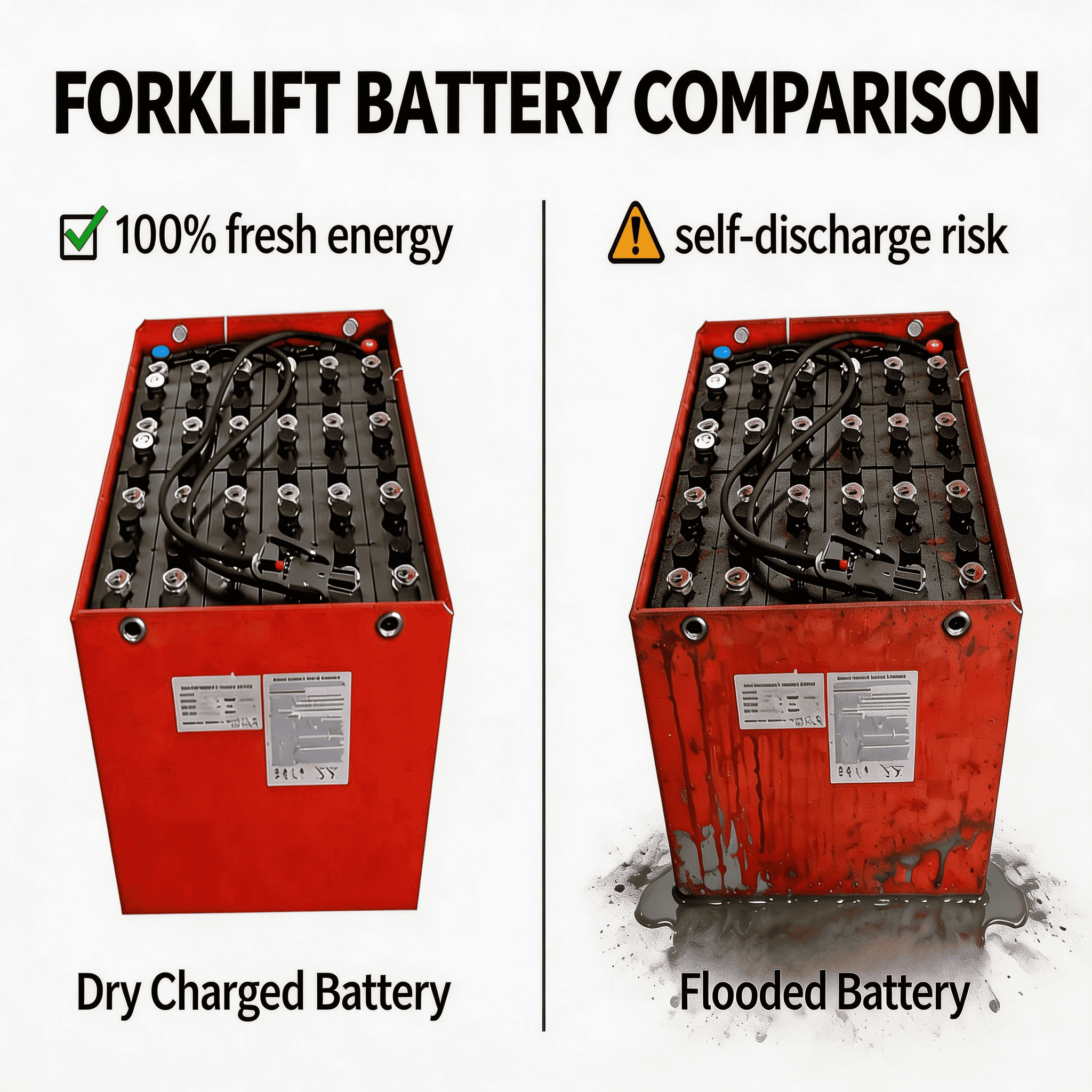
Traditional diesel and conventional flooded lead-acid heavy forklifts suffer catastrophic mechanical and electrical failures under stamping shop duty cycles:
| サブシステムの構成要素 | Heavy IC Diesel Forklifts (10T to 25T) | 浸水した鉛蓄電池式電動フォークリフト | ZOSPOWER Heavy-Armor LiFePO4 Systems |
|---|---|---|---|
| Structural & Cell Integrity under Shock | Radiator brackets crack; exhaust downpipes shear under 20G floor shock loads; continuous oil leaks near press pits. | Heavy lead-antimony plates crack at post connections; internal active material sloughs off, causing sudden dead cell shorts. | 12mm to 16mm Q235B robotically welded armor steel casing; internal high-damping cellular polyurethane shock mounts. |
| Hydraulic Hoist Power & Voltage Sag | Hydraulic pump lag during cold engine starts; loud engine revving creates indoor noise exceeding 85 dBA. | Severe voltage sag drops battery busbar from 80V to 62V under 18T die lift; hoist speed decays by 35% below 50% SOC. | Continuous 2C to 3C pulse discharge rates; rigid terminal voltage stability maintaining 100% full-speed lifting even at 20% SOC. |
| Die Changeover (SMED) Fleet Availability | Refueling trucks inside stamping buildings creates fire hazards near volatile drawing lubricants and oil mists. | Requires 8 hours charging + 8 hours cooling; crane battery swapping in tight die aisles causes acute safety risks. | 1C to 1.5C automated opportunity charging during die storage staging; 24/7 non-stop availability without battery removal. |
| Indoor Air Quality & Zero-Emission Mandates | Emits heavy particulate matter (PM2.5) and diesel soot that contaminates precision optical sheet inspection cameras. | Emits sulfuric acid aerosol and corrosive hydrogen ($H_2$) gas during heavy fast charging, rusting adjacent steel dies. | 100% zero emissions, zero off-gassing, completely clean operation preserving automated robotic inspection systems. |
3. ZOSPOWER Structural & Electrical Engineering for Die Handling
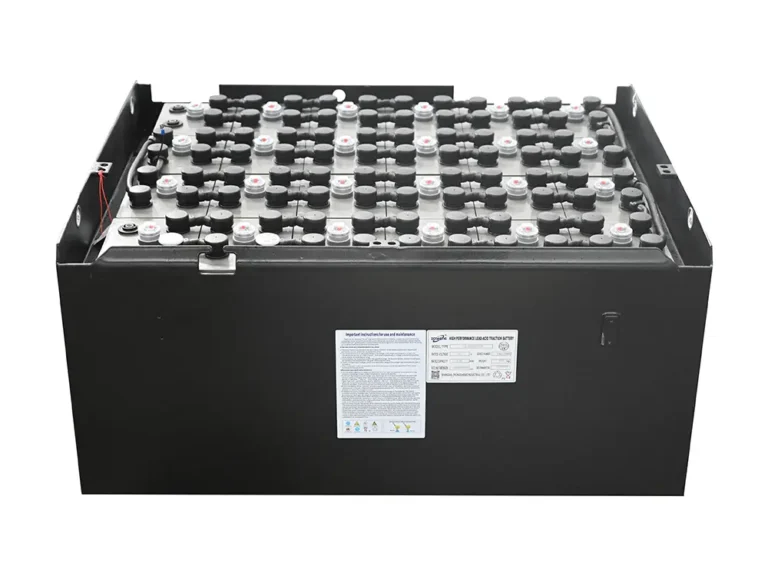
ZOSPOWER engineers custom ultra-high-capacity 80V, 96V, and 120V LiFePO4 battery assemblies (ranging from 600Ah to 1,200Ah) designed specifically for 10-ton to 25-ton heavy electric forklifts (e.g., Kalmar, Konecranes, Hyster, Linde Heavy):

- Heavy-Armor Structural Ballast Enclosure: Fabricated from 12mm to 16mm heavy structural steel plates with internal triangular gusset reinforcements. The battery pack doubles as a certified counterweight ballast (Minimum Service Weight compliance), maintaining optimal vehicle axle loading and mast stability when carrying extended load centers.
- Multi-Axis Elastomeric Shock Isolation: Internal cell modules are cradled within high-energy-absorbing microcellular polyurethane pads and high-damping silicone isolators. This internal suspension dampens 25G floor impacts down to <2.5G at the cell level, protecting cell terminals and internal foils from shear fatigue.
- Flexible Laminated Copper Foil Busbars: Eliminates rigid solid busbars between cells. All cell-to-cell interconnections utilize diffusion-welded multi-layer laminated copper foil shunts ($A \ge 120\ ext{mm}^2$) insulated with heat-shrinkable silicone sleeves, absorbing structural frame flexure without mechanical fatigue.
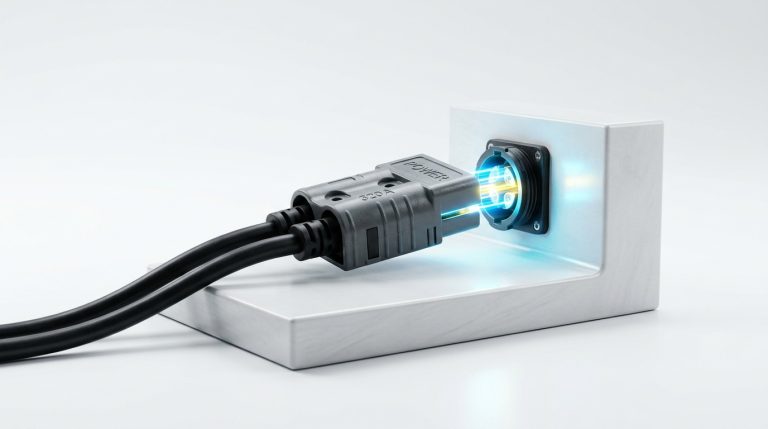
- High-Current Ceramic Vacuum Contactors & PDU: Integrated with our heavy-duty DC PDU architecture そして magnetic blowout contactors rated for 1,000A continuous and 2,000A inrush current, preventing contact welding during sudden hydraulic motor stalls.
4. Five-Year Fleet TCO & Operational Financial Model
The financial justification for transitioning heavy stamping fleet operations to high-capacity lithium traction is demonstrated below, based on an automotive OEM stamping plant operating 10 heavy counterbalance forklifts (12T to 18T capacity) across three intensive shifts (7,200 operating hours/year per truck):
| Cost Category (10 Heavy Die Forklifts, 5-Year Horizon) | Heavy IC Diesel Fleet | Flooded Lead-Acid Fleet (2 Packs/Truck) | ZOSPOWER Heavy-Duty LiFePO4 Fleet |
|---|---|---|---|
| Fuel / Electrical Energy Cost | $1,512,000 (Diesel @ $3.80/gal, 3.5 gal/hr avg.) | $540,000 (Grid power @ $0.12/kWh, 68% efficiency) | $372,000 (Grid power @ $0.12/kWh, 96% efficiency) |
| Battery Replacement & Pack Capital | $0 (Heavy diesel powertrains) | $480,000 (20 heavy 80V packs replaced at Yr 2.5) | $290,000 (10 armored LiFePO4 packs, 10-yr design life) |
| Maintenance, Oil Changes & Shock Repairs | $450,000 (Radiators, engine rebuilds, exhaust shears) | $320,000 (Cracked plate repairs, cable melting) | $38,000 (Routine mechanical brake/fluid checks) |
| Battery Swapping & Crane Labor Cost | $90,000 (Daily refueling & fuel spill cleanup) | $270,000 (Overhead crane battery swapping downtime) | $0 (Automated opportunity charging during shift breaks) |
| Press Line Downtime Penalty (SMED Lag) | $180,000 (Slow cold hydraulic hoist & engine stalls) | $360,000 (Voltage drop hoist slowdowns & dead trucks) | $0 (Instant full-torque hydraulic response, zero lag) |
| 5年間のライフサイクルコスト合計 | $2,232,000 | $1,970,000 | $700,000 |
| 5年間の純財務的節約額 | $1,532,000 SAVED | $1,270,000 SAVED | OPTIMUM BASELINE |
| 投資回収期間 | 9.5 Months | 11.1 Months | — |
5. Fleet Electrification Implementation Roadmap for Press Shops
To ensure a flawless transition without interrupting continuous vehicle stamping operations, plant engineering directors should follow a structured rollout:
- Die Weight & Center of Gravity Audit: Catalog the plant’s top 20 heaviest stamping dies and measure exact forward load center offsets ($LC$). Specify custom battery ballast steel thicknesses to ensure compliant axle weight distribution under maximum tilt angles.
- Strategic Opportunity Charging Grid: Install high-power industrial fast chargers (80V/120V up to 400A) along primary die transport aisles and near tool maintenance toolrooms, enabling 15-minute high-rate opportunity charges that keep trucks operational around the clock.
- Telematics & Predictive Shock Telemetry: Deploy onboard 3-axis accelerometer telematics integrated into the vehicle’s BMS. Monitor real-time dynamic G-forces, floor condition degradation, and pack insulation resistance, scheduling floor plate repairs before structural chassis fatigue occurs.
Electrify Your Heavy Stamping Fleet with ZOSPOWER
ZOSPOWER manufactures ultra-rugged, armored LiFePO4 battery systems and heavy-current charging infrastructure engineered to conquer the extreme shock loads, massive payloads, and rapid turnaround cycles of global automotive stamping plants.
Contact our heavy-vehicle electrification team today to review structural drawings, calculate counterweight ballast requirements, and engineer a custom lithium retrofit for your stamping die fleet.