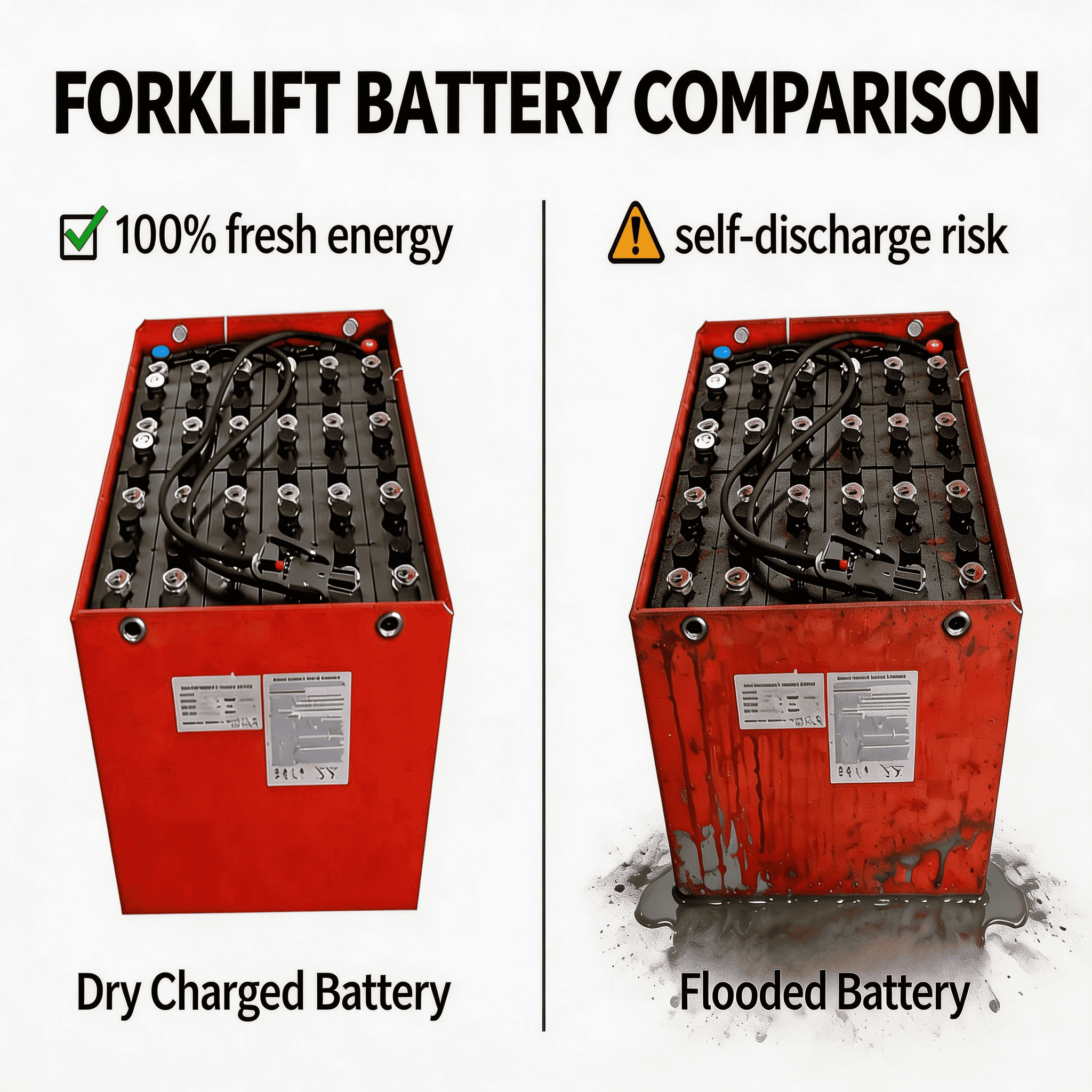
Pharmaceutical manufacturing plants, sterile active pharmaceutical ingredient (API) synthesis suites, and biotechnology formulation hubs operate under the world’s most uncompromising contamination controls. Regulated under FDA 21 CFR Part 211 and EU GMP Annex 1, cleanroom environments classified as ISO 14644-1 Class 5 (Grade B) and Class 7 (Grade C) prohibit airborne particulate generation, microbial harborage, and volatile chemical outgassing. Historically, materials handling inside secondary packaging and airlock staging relied on manual hydraulic jacks or bulky pneumatic equipment because conventional industrial forklifts were disqualified. Traditional flooded or VRLA lead-acid batteries emit corrosive sulfuric acid ($H_2SO_4$) aerosols, toxic lead particulate fallout, and flammable hydrogen gas ($H_2$), causing immediate regulatory shutdown during sterility audits. This engineering analysis explores how hermetically sealed, non-offgassing LiFePO4 power architectures, static-dissipative chassis grounding, and AISI 316L cleanroom-grade electric pallet trucks ensure flawless GMP compliance, worker safety, and superior 5-year fleet economics in 2026.
1. The Severe Regulatory Matrix: Airborne Particulates & Solvent Vapors
Cleanroom materials handling equipment operates under dual regulatory scrutiny: sterile biological particulate suppression and volatile solvent explosive safety:
- Airborne Particulate Limits (ISO 14644-1): In an ISO Class 7 cleanroom, the airborne concentration of particles $\ge 0.5\ \mu\text{m}$ cannot exceed 352,000 particles/$m^3$; in Class 5, it is capped at just 3,520 particles/$m^3$. Conventional carbon-brush electric motors, open lead-acid battery venting caps, and flaking painted steel chassis generate millions of microscopic metallic and chemical particles per minute, immediately ruining sterility validations.
- Chemical Outgassing & Volatile Organic Contaminants: Lead-acid cells release hydrogen-acid aerosol mixtures during operation and recharging. Airborne sulfate ions ($SO_4^{2-}$) neutralize alkaline sterile buffers, catalyze API oxidation, and corrode expensive 316L HVAC HEPA/ULPA filtration grids.
- ATEX Zone 1/21 Solvent Flammability (API Synthesis): API extraction and crystallization suites frequently handle volatile solvents including ethanol, acetone, isopropanol (IPA), and dichloromethane. Drive wheels moving across resin floors generate triboelectric static charges exceeding 15 kV, creating severe spark ignition hazards unless chassis conductivity is continuously dissipated ($\le 10^6\ \Omega$).
“Equipment shall be constructed so that surfaces that contact components, in-process materials, or drug products shall not be reactive, additive, or absorptive so as to alter the safety, identity, strength, quality, or purity of the drug product.” Lead-acid battery emissions are legally classified as an adulterating chemical additive.
2. Hygienic Hermetic Lithium Engineering for Cleanroom Fleets
To operate safely inside classified pharmaceutical suites, ZOSPOWER cleanroom power systems eliminate all outgassing pathways and microbial collection crevices:
| Cleanroom Metric | Conventional VRLA / Gel Battery | ZOSPOWER Cleanroom LiFePO4 System |
|---|---|---|
| Gaseous Emission & Aerosol Outgassing | Hydrogen ($H_2$) + trace $H_2SO_4$ aerosol | 100% Zero-Emission (Hermetically Sealed Prismatics) |
| Enclosure Material & Surface Roughness | Painted carbon steel ($Ra \ge 6.3\ \mu\text{m}$) | AISI 316L Electro-polished Stainless Steel ($Ra \le 0.4\ \mu\text{m}$) |
| Chemical Disinfectant Resistance | Paint blisters under IPA & Spor-Klenz | Impervious to 70% IPA, Hydrogen Peroxide Vapor (VHP) |
| Static Dissipation & Earthing Path | Insulated rubber mounts ($R > 10^{10}\ \Omega$) | Conductive carbon-doped composite straps ($R \le 10^6\ \Omega$) |
| Recharge Infrastructure Location | Mandatory external battery room | In-situ opportunity charging in staging airlocks |
3. Static Dissipation Mechanics & ATEX Zone 1/21 Earthing Topology
When electric pallet trucks transport drums of flammable organic solvents across conductive epoxy cleanroom flooring, continuous tire rolling generates electrostatic charges via triboelectric contact separation. The accumulated chassis potential $V_{\text{static}}$ is governed by:
$$V_{\text{static}} = \frac{Q}{C_{\text{truck}}} = \frac{I_{\text{tribo}} \cdot R_{\text{path}}}{1 + \frac{t}{\tau_{\text{bleed}}}}$$
Where $\tau_{\text{bleed}} = R_{\text{path}} \cdot C_{\text{truck}}$. If contact resistance across tires and battery mounting brackets exceeds $10^9\ \Omega$, electrostatic potential rapidly reaches 12,000V to 18,000V. An accidental discharge spark against an earthed stainless steel cleanroom wall releases energy:
$$E_{\text{spark}} = \frac{1}{2} C_{\text{truck}} \cdot V_{\text{static}}^2 \approx \frac{1}{2} (220 \times 10^{-12}\text{ F}) \cdot (15,000\text{ V})^2 \approx 24.75\text{ mJ}$$
Because the Minimum Ignition Energy (MIE) of solvent vapors like acetone is just 1.15 mJ and isopropanol is 0.65 mJ, a 24.75 mJ spark triggers catastrophic vapor-cloud ignition. ZOSPOWER incorporates anti-static carbon-nanotube conductive grounding links and bonded conductive polyurethane drive wheels ($\rho_s \le 10^5\ \Omega\cdot\text{cm}$), continuously bleeding electrostatic potential to ground so that $V_{\text{static}}$ never exceeds 50V ($E_{\text{spark}} < 0.0003\text{ mJ}$), safely below the solvent MIE envelope.
4. Hydrogen Peroxide Vapor (VHP) Sterilization & Airlock Integration
Before any equipment enters an ISO Class 5 filling suite, it must undergo automated bio-decontamination inside an airlock chamber using Vaporized Hydrogen Peroxide (VHP, 1,200–1,500 ppm concentration):
- VHP Chemical Penetration Barrier: Hydrogen peroxide vapor is intensely oxidizing. ZOSPOWER battery enclosures feature precision-machined Viton / FKM O-ring seals and non-porous Gore-Tex ePTFE oleophobic pressure vents, preventing VHP gas from reaching internal circuit boards or lithium cell terminals.
- Conformal Parylene-C Nanocoating: The internal BMS PCB is encapsulated via automated chemical vapor deposition (CVD) of Parylene-C (MIL-I-46058C approved), providing absolute pinhole-free dielectric barrier protection against condensation and sterilant permeation.
- Sanitary Opportunity Docking in Airlocks: Compact 24V/48V stainless steel charging contact posts installed inside material transfer airlocks deliver high-speed 1C opportunity top-ups while pallets undergo 30-minute VHP cycle aeration.
5. 5-Year Fleet Total Cost of Ownership: Cleanroom Electric Pallet Fleets
Financial comparison for a biotech formulation campus operating a fleet of twelve 1.5-tonne cleanroom-grade stainless electric pallet trucks:
| Cost Category (12 Trucks, 5 Years) | Standard Gel/AGM Sealed Lead-Acid | ZOSPOWER Cleanroom LiFePO4 System |
|---|---|---|
| Initial Equipment & Charger CapEx | $144,000 (24 AGM packs + 12 chargers) | $188,000 (12 LiFePO4 packs + 6 fast chargers) |
| Cleanroom HVAC Filter Replacement Costs | $125,000 (particulate fouling of HEPA banks) | $15,000 (zero particulate contamination) |
| Airlock Battery Transfer & Disinfection Labor | $195,000 (manual swapping outside clean zone) | $0 (Zero battery removal; airlock fast charging) |
| Battery Replacements (18-Month Lead Degradation) | $96,000 (premature failure in cold cleanrooms) | $0 (LiFePO4 warranty > 4,000 cycles) |
| Sterility Audit Contingency & Risk Provisions | $80,000 (FDA 483 observation mitigation reserve) | $0 (Certified Class 5/7 compliance) |
| Total 5-Year Life Cycle Expenditure | $640,000 | $203,000 |
Net 5-Year Cost Reduction: $437,000 USD across 12 cleanroom trucks, achieving full capital payback within 9.2 months.
6. ZOSPOWER Engineering: Certified Sterile Materials Handling Power
ZOSPOWER engineers sanitary, zero-particulate lithium power packs for leading global cleanroom vehicle manufacturers and pharmaceutical fleet operators:
- Full 316L Electro-Polished Construction: Weld seams ground flush and mirror-polished to prevent bacterial biofilm adhesion.
- Hermetic IP67/IP69K Enclosures: Fully submersible and impervious to high-concentration disinfectant wipe-downs and VHP cycles.
- Integrated Anti-Static Safety Shunts: Grounding paths verified to exceed EN 1755 and ATEX Zone 1/21 explosion-safety directives.
Validate Your Cleanroom Fleet with ZOSPOWER
Eliminate particulate contamination, pass FDA and EU GMP audits with confidence, and prevent solvent spark hazards. Connect with ZOSPOWER pharmaceutical electrification engineers to specify certified cleanroom lithium solutions for your sterile facility.