Deep-sea maritime container terminals, intermodal rail yards, and inland dry ports represent the pinnacle of heavy industrial material handling tonnage. Operating around the clock to meet vessel demurrage windows, heavy container handling machinery—specifically 45-metric-ton laden reachstackers and 8-high empty container handlers (ECH)—endures punishing mechanical duties: 450 kN spreader shock pulses, continuous marine salt-spray fog, torrential monsoon storms, and severe aerodynamic wind loading at heights exceeding 24 meters. Traditionally dominated by massive 11-liter to 13-liter turbo-diesel engines burning upwards of 35 liters of fuel per operating hour, port terminal authorities worldwide are accelerating wholesale decarbonization under IMO 2030 and EU Fit for 55 green port mandates. By 2026, heavy-duty 600V–800V lithium iron phosphate (LiFePO4) powertrains are transforming port logistics. This technical white paper examines severe marine atmospheric containment (ISO 12944 CX), electro-hydraulic gravitational energy harvesting, dynamic 450 kN spreader impact mitigation, and multi-megawatt recharge à la demande architectures governing next-generation container terminals.
| Port Operational Metric | 45-Ton Tier-4 Final Diesel Reachstacker | 45-Ton High-Voltage LiFePO4 Electric Reachstacker | Terminal Yard Impact |
|---|---|---|---|
| Coût horaire du carburant / de l'énergie | 28 to 38 Liters/hr ($44.80–$60.80/hr) | 42 to 58 kWh/hr ($5.88–$8.12/hr) | 84%–87% direct operating energy cost reduction |
| Container Lowering Potential Energy | Wasted as fluid heat in hydraulic coolers (throttle loss) | Regenerated directly to battery pack via H-ERS pump-motor | Recovers 22%–26% of gross hoisting energy |
| Marine Atmosphere Corrosion | Corrosive salt fog degrades copper wiring looms & turbos | Hermetic IP67/IP69K 316L stainless steel enclosure armor | Rated for ISO 12944 CX Extreme Marine coastal durability |
| Full-Load Breakout Acceleration | Sluggish hydraulic converter lag (~3.5 sec to full stall speed) | Instantaneous full-rated torque delivered at 0 RPM (<100 ms) | +18% higher container box handling cycles per crane hour |
| Terminal Acoustic Footprint | 92 to 102 dBA continuous roar across quay and yard | <68 dBA whisper-quiet operation | Enables compliant nighttime residential-adjacent operations |
1. The Green Port Imperative: Quayside Emissions, Demurrage & Fuel Volatility
Modern international container ports handle thousands of TEUs (Twenty-Foot Equivalent Units) every 24 hours. A standard terminal operating a fleet of 30 laden reachstackers and 20 empty container handlers consumes between 3.5 million and 5.0 million liters of diesel fuel annually. This immense combustion footprint introduces compounding operational vulnerabilities:
- Severe Quayside Carbon Penalties: Under IMO Net-Zero Frameworks and regional cap-and-trade systems (such as the European Union Emissions Trading System, EU ETS), terminal operators face escalating financial penalties for quayside particulate soot, carbon monoxide, and NOx emissions generated adjacent to container berths.
- Thermal Throttle Losses during High-Speed Stacking: Lowering a fully laden 40-foot reefer container (mass $m = 40,000\text{ kg}$) from a 5-high stack ($h = 13.5\text{ meters}$) releases massive gravitational potential energy:
$$E_{potential} = m \cdot g \cdot h = 40,000\text{ kg} \times 9.81\text{ m/s}^2 \times 13.5\text{ m} \approx 5.30\text{ MJ } (1.47\text{ kWh})$$
In a diesel reachstacker, this 1.47 kWh of energy is dumped across a mechanical counterbalance valve directly into the hydraulic oil, heating the reservoir to over 85°C and demanding massive hydraulic oil cooler fans that waste additional diesel. - Vessel Turnaround Demurrage: Ultra-Large Container Vessels (ULCVs) carrying 24,000 TEU incur carrier demurrage fees exceeding $80,000 per idle day. Terminal reachstacker fleets cannot afford engine downtime, turbocharger replacements, or DPF regeneration lockouts during vessel work orders.
2. Gravitational Electro-Hydraulic Energy Harvesting (H-ERS)
To maximize operational range on a single charge, ZosPower-integrated electric reachstackers implement an advanced Hydraulic Energy Recovery System (H-ERS):
When the heavy boom lowers an elevated container, return hydraulic fluid from the massive main lift cylinders is routed not to the tank, but directly into a bidirectional bent-axis hydraulic pump-motor. The falling load acts as a fluid prime mover, spinning a high-voltage permanent magnet generator:
$$ ext{Descending 40-Ton Payload} \longrightarrow ext{High-Pressure Fluid Stream} \longrightarrow ext{Hydraulic Motor} \longrightarrow ext{PMSM Generator} \longrightarrow ext{LiFePO4 Pack (+120 kW)}$$
By capturing 72% of fluid kinetic energy and converting it back into electrochemical storage with high-voltage DC-link regeneration, the electric reachstacker reclaims 22% to 26% of its gross hoisting energy throughout a standard container shunting shift. This drastically reduces net kilowatt-hour consumption per box moved and prevents hydraulic fluid thermal breakdown.
3. Severe Marine Environment Protection: ISO 12944 CX Extreme Coastal Sealing
Ocean ports present an intensely corrosive electrochemical environment. High-velocity sea breezes carry chloride-saturated brine aerosols ($ ext{Cl}^-$ concentration >300 mg/m²/day), while quay surfaces are swept by sea spray and tropical monsoon downpours:
- ISO 12944 CX Extreme Marine Protective Armor: ZosPower port-grade battery housings are fabricated from high-yield 8mm structural steel pre-treated with zinc-nickel alloy immersion and electro-deposited epoxy primers, topped with two-component aliphatic polyurethane topcoats certified for 25-year coastal durability under ISO 12944 CX environments. Critical inspection covers, cable glands, and pressure vents utilize marine-grade 316L austenitic stainless steel.
- Dual-O-Ring Hermetic IP67 / IP69K Sealing: Perimeter sealing interfaces feature dual Viton/EPDM elastomeric gaskets with dedicated moisture drain channels, preventing saltwater penetration during high-pressure 100-bar quayside washdowns.
- Active Insulation Resistance Tracking & Leakage Interlocking: Coastal moisture creates high risk of surface salt tracking. The integrated Battery Management System continuously pulses high-frequency AC isolation signals across the 800V DC bus in compliance with ISO 6469-1. If salt residue causes chassis leakage resistance to dip below 500 Ω/V, the system triggers predictive maintenance warnings on the terminal telematics dashboard before contactors are permitted to engage.
4. 450 kN Spreader Drop & Twistlock Dynamic Shock Attenuation
Empty container handlers and reachstackers do not maneuver softly. When a 45-ton reachstacker’s top-lift telescopic spreader lands on the corner castings of a stationary container or when the twistlocks mechanically engage, severe shock pulses radiate through the boom:
- 450 kN Peak Landing Shock: Spreader landing forces peak at 350 kN to 450 kN, transmitting severe high-frequency vibrational waves down the telescopic boom cylinder and chassis spine.
- Multi-Axis Heavy-Duty Elastomer-Hydraulic Mounts: The primary 450 kWh to 600 kWh battery pack does not bolt directly to the chassis frame. It is suspended on four multi-directional elastomer-hydraulic composite snubbers tuned to attenuate 15 Hz–40 Hz impact harmonics by over 78%.
- Reinforced Cell Group Compression: Internal prismatic LiFePO4 cells are clamped between 10mm aircraft-grade aluminum endplates under 3,500 N of uniform mechanical pre-load, preventing any internal delamination of active cathode/anode layers under thousands of repetitive twistlock docking cycles.
5. Fast Megawatt Opportunity Charging (MCS) & Dual-Gun CCS2 Integration
Deep-sea container terminals cannot operate with four-hour charging interruptions. Port equipment operates around the clock across three continuous 8-hour shifts:
| Charging Architecture | Single-Gun CCS2 (160 kW) | Dual-Gun Boost CCS2 (360 kW) | Megawatt Charging System (MCS – 600 kW+) |
|---|---|---|---|
| Peak Charging Current | 200A continuous DC | 450A continuous (dual cables) | 800A to 1,200A liquid-cooled |
| 20% to 80% SOC Charge Time | 120 minutes (impractical for 24/7) | 50 minutes (shift-break window) | 18 to 25 minutes (turnaround buffer) |
| Cable Handling Ergonomics | Standard air-cooled cable | Dual air-cooled cables | Active liquid-cooled ergonomic tether |
| Terminal Infrastructure Fit | Small maintenance depot | Container yard staging bays | Quayside berth buffer & gate interchange |
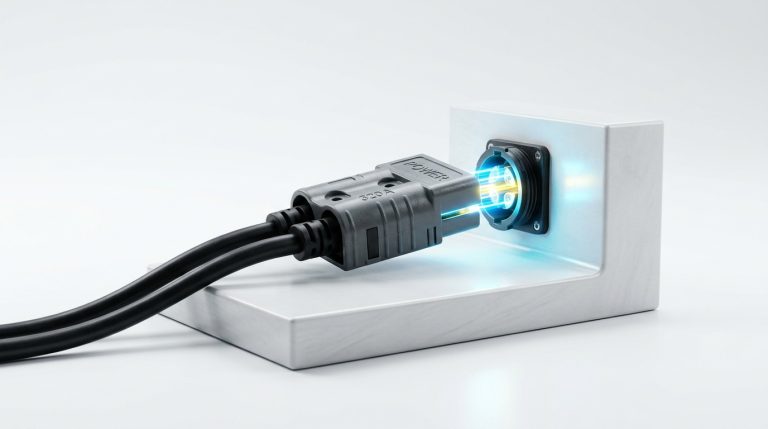
By installing 400 kW to 600 kW MCS charging stations at container interchange checkpoints and driver break staging areas, reachstacker operators connect during routine 15-to-20-minute driver rest breaks. Drawing continuous 1.5C charging current, the pack absorbs enough energy to power another four hours of continuous heavy container stacking, establishing an unbroken 24/7 terminal duty cycle without mechanical pack swapping.
6. Five-Year Port TCO Financial Model: 45-Ton Diesel vs. Electric Reachstacker
Evaluating a heavy maritime container terminal operating a 45-ton reachstacker across a continuous 5,000-hour annual schedule (25,000 operating hours over 5 years) proves the crushing economic superiority of lithium electrification:
| Cost Category (5 Years / 25,000 Operating Hours) | 45-Ton Diesel Reachstacker | 45-Ton ZosPower LiFePO4 Electric Reachstacker | Container Terminal Net Savings |
|---|---|---|---|
| Primary Fuel / Electricity Cost | $1,360,000 (at $1.60/L, 34 L/hr) | $225,000 (at $0.18/kWh, 50 kWh/hr net) | $1,135,000 Saved |
| Engine, Turbo & Transmission Rebuilds | $285,000 (2 major transmission rebuilds + oil) | $45,000 (gearbox oil & cooling circuit flushes) | $240,000 Saved |
| Hydraulic Fluid Replacement & Coolers | $95,000 (high thermal degradation) | $32,000 (H-ERS eliminates thermal boiling) | $63,000 Saved |
| Remplacement des disques de frein à friction | $80,000 (replaced every 3,500 hours) | $20,000 (regenerative drive takes 80% load) | $60,000 Saved |
| Equipment Acquisition (CapEx & 400kW Charger) | $580,000 | $850,000 (includes 520kWh pack & DC fast charger) | ($270,000 Initial Premium) |
| Coût total de possession net sur 5 ans | $2,400,000 | $1,172,000 | $1,228,000 Net Savings |
The upfront electrification premium of $270,000 is fully amortized within 11.8 months of continuous port container operations. Over five years, a single electric reachstacker generates $1.228 million in net bottom-line cash savings while eliminating over 2,200 metric tons of carbon emissions.
Electrify Your Port Container Fleet with ZOSPOWER
Are high marine diesel expenditures, severe salt fog corrosion, and quayside carbon emission caps impacting your port terminal throughput? ZosPower engineers ultra-heavy, high-voltage (600V to 850V) lithium iron phosphate (LiFePO4) power systems specifically customized for 45-ton reachstackers, empty container handlers, and heavy terminal tractors.
Contact our senior maritime container terminal electrification specialists today for electrical schematics, duty-cycle energy simulations, and turnkey quayside megawatt fast-charging infrastructure solutions.