Industrial abattoirs, poultry slaughtering lines, and cold food processing facilities present one of the most chemically aggressive and biologically scrutinized operational environments in global logistics. To eradicate microbial pathogens such as Listeria monocytogenes, Salmonella, 그리고 E. coli, regulatory bodies including the USDA, FDA, and EU Food Safety Authorities mandate severe end-of-shift sanitization protocols. Materials handling equipment is subjected nightly to caustic chlorinated foam degreasers (pH 11.5–13.0), followed by 80°C (176°F) scalding-water washdowns at dynamic pressures exceeding 100 bar (1,450 psi). Under these conditions, traditional internal combustion trucks and conventional lead-acid battery enclosures suffer rapid structural corrosion, moisture-induced insulation breakdown, and chronic electronic failures. This technical analysis explores the transition toward IP69K-sealed stainless steel electric counterbalanced and pallet trucks, advanced hermetic thermal engineering, and 5-year fleet total cost of ownership (TCO) in 2026.
1. The Triple Biological & Chemical Hazard Matrix in Food Abattoirs
Unlike standard ambient warehousing or dry refrigerated storage, meat and poultry packing floors operate as active biological hazard zones. Industrial trucks face three simultaneous environmental stressors:
- Corrosive Organic Slurry & Acidic/Basic Chemistry: Floors are continuously coated with animal fats, blood, saline brine solutions, and organic acids. Nightly cleaning applies high-alkaline sodium hydroxide (NaOH) foams to emulsify fats, alternating with peracetic acid or nitric acid descalers (pH 2.0–3.0) to remove mineral scale. Standard painted carbon steel frames and polyurethane seals blister, crack, and delaminate within 6 to 9 months.
- 80°C High-Pressure Thermal Shock (DIN 40050-9 / ISO 20653 IP69K): High-velocity hot water spray nozzles directed at fork carriages, chassis underbellies, and battery bays trigger severe thermal contraction-expansion cycles. As exterior surfaces heat to 80°C and then chill rapidly back down to the +2°C chill-room ambient, interior air volumes create an instantaneous negative pressure vacuum ($\Delta P \approx -180\text{ to } -250\text{ mbar}$), sucking corrosive caustic mist past ordinary IP54/IP65 gasket seals.
- Microbial Harborage & Zero-Crevice Hygienic Mandates: Standards such as EHEDG (European Hygienic Engineering & Design Group) and NSF/ANSI 3-A prohibit open hollow tubing, exposed fastener threads, and overlapping sheet seams where organic waste can ferment and harbor bio-films.
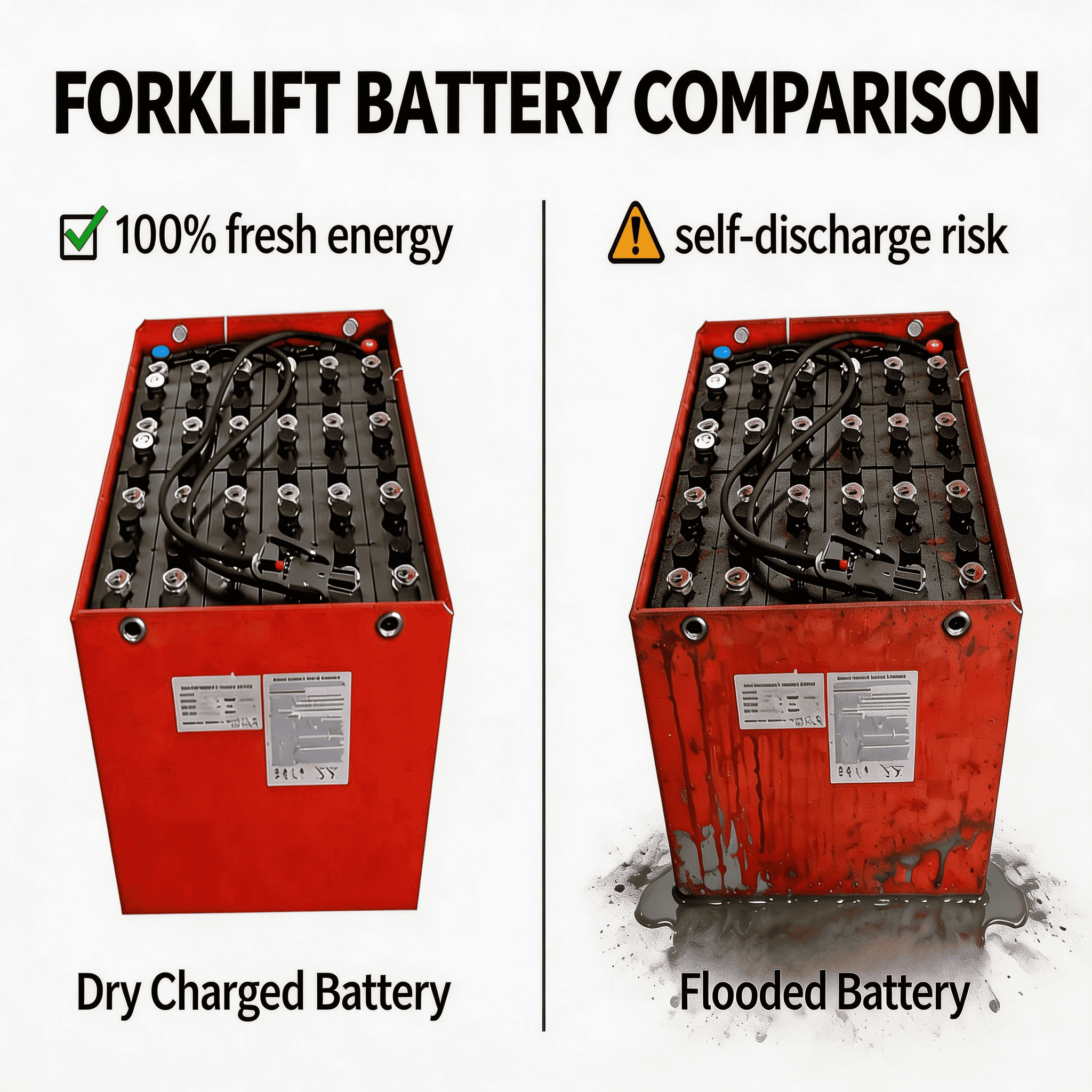
Lead-acid batteries are fundamentally non-compliant in open-food abattoirs. The presence of vented lead-antimony/calcium caps, toxic liquid sulfuric acid ($H_2SO_4$), outgassing hydrogen-acid mist, and heavy lead terminal posts creates severe cross-contamination risks under strict HACCP audits. Complete transition to hermetically sealed LiFePO4 battery architectures is becoming mandatory for Tier-1 protein exporters.
2. IP69K Hermetic Enclosure Engineering: Materials & Pressure Management
To survive continuous 100 bar, 80°C omnidirectional water jets without allowing a single droplet of moisture to penetrate sensitive lithium cell arrays, ZOSPOWER washdown power systems employ military-grade hermetic packaging principles:
| Subsystem Component | Conventional Cold-Store Forklift | Hygienic IP69K Abattoir Specification |
|---|---|---|
| Battery Chassis Material | Powder-coated A36 structural carbon steel | AISI 316L / DIN 1.4404 Passivated Austenitic Stainless Steel (Mo ≥ 2.5%, non-pitting) |
| Enclosure Surface Finish | Industrial textured powder paint ($Ra \approx 6.3\ \mu\text{m}$) | Electro-polished mirror finish ($Ra \le 0.4\ \mu\text{m}$), zero bacterial adhesion crevices |
| Gasket Sealing Topology | Flat EPDM open-cell sponge strip (IP54) | Dual tongue-and-groove molded fluorosilicone / FKM seals, impervious to caustic NaOH & chlorine |
| Internal Pressure Equalization | None (rigid box suffers vacuum water ingestion) | Hydrophobic/Oleophobic ePTFE Dual Breather Valves (IP69K rated, burst > 350 mbar) |
| High-Power Connectors | Standard open-face REMA / Anderson plastic plugs | Hermetic bayonet circular interlock connectors with gold-plated pins & Viton O-rings |
3. Mathematical Thermodynamics: Thermal Shock Vacuum Suppression
When an 80°C washdown jet strikes a cool battery case, heat transfer into the enclosure air volume is rapid, followed by a dramatic drop when cold rinsing begins. According to the ideal gas law ($P \cdot V = n \cdot R \cdot T$), with a rigid internal volume $V_0 \approx 0.18\text{ m}^3$:
If an air pocket at temperature $T_{\text{hot}} = 65^\circ\text{C}$ (338.15 K) cools instantaneously to $T_{\text{cold}} = 2^\circ\text{C}$ (275.15 K) without atmospheric venting:
$$P_2 = P_1 \cdot \left(\frac{T_2}{T_1}\right) = 1,013\text{ mbar} \cdot \left(\frac{275.15}{338.15}\right) = 824.3\text{ mbar}$$
$$\Delta P = 824.3 – 1,013 = -188.7\text{ mbar}$$
This negative differential pressure of nearly -0.19 bar exerts a continuous suction force of $F = \Delta P \cdot A$ across the gasket perimeter ($A \approx 0.42\text{ m}^2$), representing an inward pulling force of 7,925 Newtons. Under external 100 bar water impingement, water will penetrate any standard mechanical joint lacking active dynamic pressure equalizing membranes.
ZOSPOWER installs dual hydrophobic/oleophobic expanded Polytetrafluoroethylene (ePTFE) acoustic-venting membranes. These membranes allow continuous bi-directional air permeation ($Q_{\text{air}} \ge 15\text{ l/min}$ at $\Delta P = 70\text{ mbar}$) to equalize pressure instantaneously, while surface tension rejects liquid water and caustic cleaning surfactants with a water entry pressure (WEP) of $>2.8\text{ bar}$.
4. Cold Chain Condensation (“Sweating”) Prevention & Active Core Heating
Abattoir vehicles constantly transition between the +2°C to +4°C carcass deboning room and the -25°C blast-freeze holding tunnels. This generates dense water condensation (“sweating”) on cold chassis surfaces. When condensation combines with airborne salt and meat protein particles, it forms an aggressive electrolyte solution:
- Conformal Coating of High-Voltage Electronics: All Battery Management System (BMS) PCBA assemblies undergo automated 3-layer Parylene vapor deposition or polyurethane potting (MIL-I-46058C compliant), insulating surface-mount components against 100% relative humidity.
- Closed-Loop Internal Silicone Core Pre-Heaters: At -25°C, lithium intercalation kinetics slow down. When plugged into opportunity chargers on the processing floor perimeter, the system activates 1.2 kW to 2.4 kW flexible silicone heating blankets, raising core prism cell temperatures above +5°C before accepting 1C fast-charge current. This prevents destructive lithium plating on graphite anodes.
- Galvanic Isolation & Solid-State Disconnect: Dual positive/negative solid-state contactors isolate the 48V/80V bus when unlatched, eliminating galvanic corrosion currents across the chassis ground.
5. 5-Year Fleet Total Cost of Ownership: Hygienic Electric vs. Lead-Acid
For a typical 24/7 poultry/beef processing facility operating a fleet of twenty 2.5-tonne electric counterbalanced and rider-pallet trucks:
| Cost Category (20 Trucks, 5-Yr Horizon) | Conventional Lead-Acid (2 Packs/Truck) | ZOSPOWER Hygienic IP69K LiFePO4 |
|---|---|---|
| Initial Battery & Charger Hardware CapEx | $220,000 (40 packs + 20 standard chargers) | $340,000 (20 IP69K packs + 10 fast chargers) |
| Daily Washdown Corrosion Repairs & Replacements | $185,000 (corroded cables, cell replacements) | $12,000 (316L stainless immunity) |
| Battery Room Labor (Swapping, Acid Refill, Cleaning) | $240,000 (2 technicians @ $60k/yr × 2 yrs dedicated) | $0 (Zero daily maintenance, opportunity charge) |
| Cold-Store Energy Consumption (Efficiency Factor) | $192,000 (68% round-trip efficiency in cold) | $128,000 (94% round-trip efficiency) |
| HACCP Audit Risk & Contamination Containment | $65,000 (spill kit maintenance, risk provisions) | $0 (100% dry sealed chemistry) |
| Total 5-Year Operating & Capital Cost | $902,000 | $480,000 |
Net 5-Year Financial Savings: $422,000 USD across 20 trucks, with capital payback achieved within 14.2 months.
6. ZOSPOWER Engineering: Hygienic Power Solutions for Global Food Plants
ZOSPOWER engineers customized, washdown-rated power packs for all major global forklift brands—including Crown, Jungheinrich, Toyota, Linde, and Hyster-Yale—specifically configured for food processing compliance:
- Full 316L Stainless Fabrication: Laser-cut, fully passivated stainless chassis eliminates any potential paint flaking into meat processing lines.
- Direct CAN Bus Integration: Real-time telematics broadcasts insulation resistance, core cell temperatures, and charging cycle metrics directly to plant SCADA and MES management systems.
- Sanitary Opportunity Charging: IP67-rated wall-mount opportunity charging stations placed outside the wet spray perimeter enable drivers to top off during 15-minute hygiene breaks.
Engineer a Washdown-Proof Fleet for Your Facility
Eliminate corrosion breakdowns, pass HACCP audits with ease, and lower cold-store power consumption. Connect with ZOSPOWER food industry electrification specialists to configure custom IP69K stainless lithium solutions tailored to your plant’s sanitization protocol.